liveBook · Manning

Forward pass

As explained in Applied Reinforcement Learning

A forward pass computes a neural network's output by propagating an input through its layers in order.

A forward pass turns raw input into a prediction by processing it layer by layer. Each layer computes a weighted sum plus a bias, then applies a nonlinear activation such as ReLU. In deep reinforcement learning, hidden layers commonly use ReLU and output layers produce Q-values. section 8.2

Figure 8.4 End-to-end learning in deep neural networks
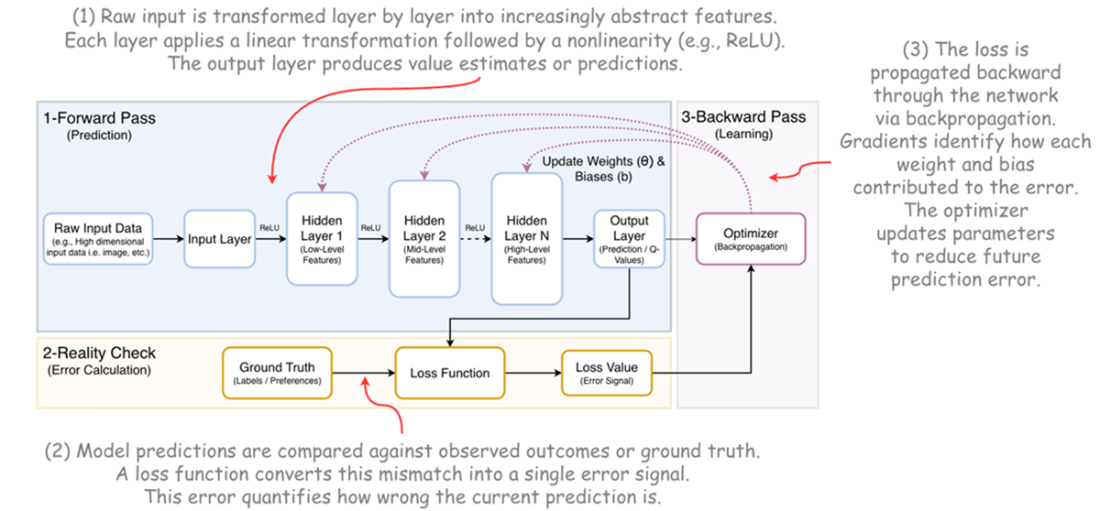
Trace the forward pass as part of the deep-network learning loop. section 8.2


How Applied Reinforcement Learning covers it

How deep it goes
Describes layer-by-layer weighted sums, biases, and nonlinear activations at a high level.
Examples
Uses images, sensor vectors, medical records, and high-dimensional state descriptions as possible inputs.
What you can do after
Understand how neural networks transform inputs layer by layer into predictions.
How it connects
Connects neural networks with function approximation, activation functions, and deep reinforcement learning.

Also explained in

Compare how 14 books explain forward pass →

Related concepts

This explainer was generated by Manning's knowledge graph from the text of Applied Reinforcement Learning. The section links point to the parts of the book it draws on.