A forward pass carries an input through a neural network to produce a prediction. At each node, inputs are weighted, summed, and combined with a bias, then transformed by an activation function: z = Σᵢwᵢxᵢ + b; a = ϕ(z). Each layer passes its transformed values to the next. Weights and biases stay fixed during the pass, so prediction occurs without learning. section 11.2 section 11.2.2
The output depends on the task:
- Regression produces a numerical prediction; binary classification produces a probability that can be compared with a decision threshold; multiclass classification produces probabilities for the possible classes. section 11.2
Pedestrian detection
A network transforms an observation into a 0.68 probability that a pedestrian is present. A threshold of 0.30 assigns the positive class and triggers braking; the forward pass itself changes no parameters. section 11.3.2
Figure 11.1 A simplified feedforward neural network containing an input layer, two hidden layers, and an output layer. Information moves forward through weighted connections to produce a prediction. During training, error information moves backward so that the weights and biases can be adjusted. Modern deep networks typically contain many hidden layers and many nodes within each layer, producing millions or even billions of adjustable parameters. Despite that scale, they follow the same basic forward-and-backward process shown here.
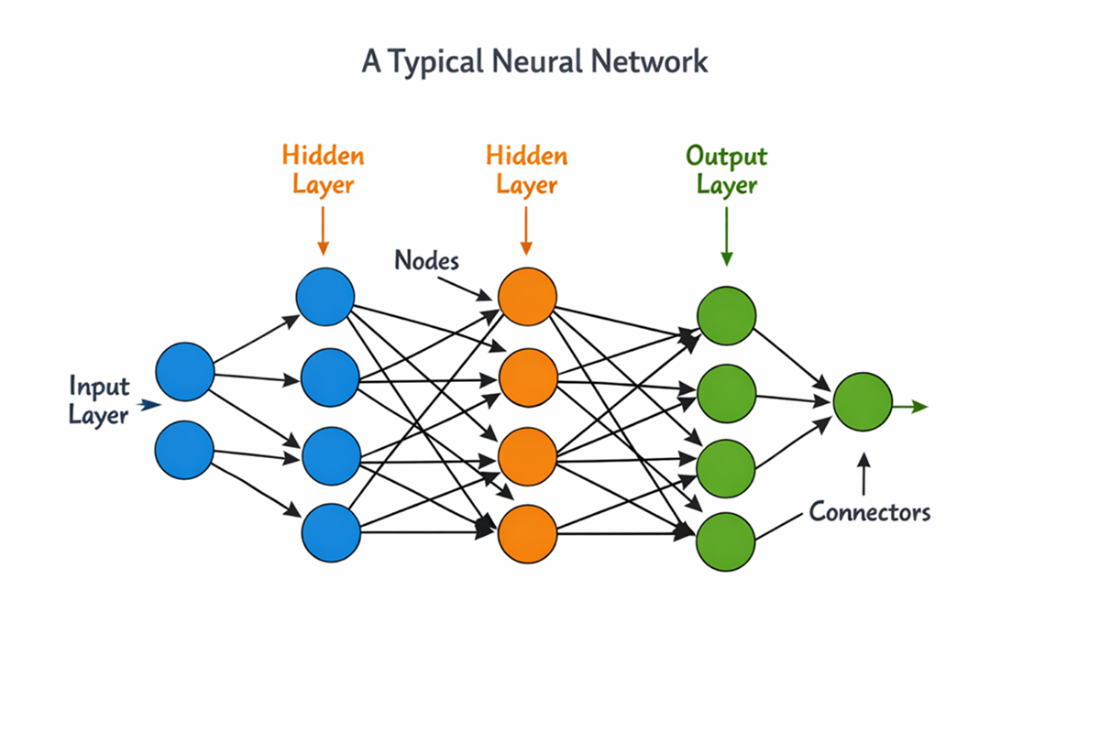
Trace how information moves through network layers to produce a prediction; training also sends error information backward to adjust parameters. section 11.2













