A forward pass is the chain of calculations that carries numerical inputs through a neural network to produce an output. Each layer transforms the signals it receives and passes its results to the next, gradually shaping the data into a response suited to the task. section 3.1.5
Neurons combine incoming values using learned weights; activation functions then reshape the resulting signals. Many neurons perform these calculations in parallel. Early layers tend to highlight simple patterns, while later layers refine them into more abstract cues. These transformations do not imply human-like understanding. section 3.1.5
Figure 3.6 A neural network processes inputs through successive layers, each reshaping the signal in a different way. Early layers tend to capture basic patterns in the data, while intermediate layers combine these signals into more informative representations. Deeper layers refine them into higher-level cues that are useful for the task. In this example, features of an email are progressively reinterpreted until the network produces a classification such as personal, work, or spam. These layer labels illustrate typical roles; in practice, the internal representations are distributed and do not correspond to fixed, human-understandable concepts.
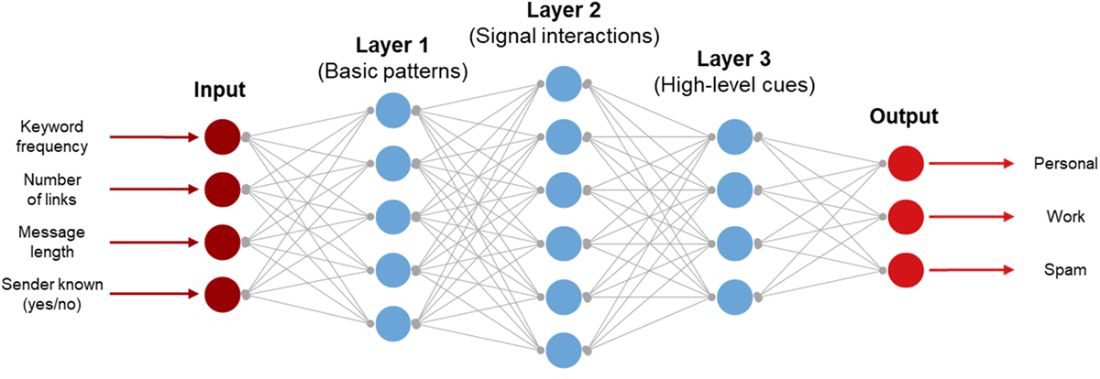
An email-classification example illustrates how successive layers reshape features toward an output such as personal, work, or spam. The layer labels are illustrative: internal representations are distributed and need not correspond to fixed, human-understandable concepts. section 3.1.5
A forward pass has a role in both training and inference. During training, the output can be compared with a desired answer using a loss; backpropagation then reveals how weights contribute to that loss, allowing an optimizer to adjust them. During inference, trained parameters are frozen, and the model typically uses only a forward pass to produce an output for a new input. Inference is generally less expensive than training, though it can still be intensive at large scales. section 3.6 section 4.6.1