Imagine red and blue sheets of paper crumpled together. The colors represent two classes that are hard to separate in their folded form. A neural network learns a transformation that gradually “uncrumples” the data until the classes are easier to distinguish. Each layer makes a small change; the stack can produce a complex change in a high-dimensional space. section 2.3.6
Figure 2.14 Uncrumpling a complicated manifold of data
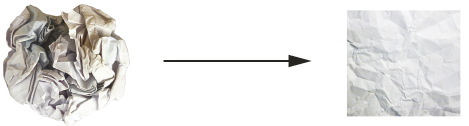
The uncrumpling diagram makes the central idea visible: transform a folded data manifold into a representation whose classes are easier to separate. section 2.3.6
In a deep learning model, these transformations are tensor operations arranged in layers. Their learned weights determine how the layers transform inputs; training adjusts those weights to reduce a loss. The useful rule of thumb is to think of a deep network as many simple transformations composed into one difficult one. section 2.3.6 section 20.1.1
A different kind of transformation: preprocessing
A dataset can also transform elements before they reach a model. For example, `dataset.map(lambda x: tf.reshape(x, (4, 4)), num_parallel_calls=8)` changes each sample’s shape from `(16,)` to `(4, 4)`. This is a specified preprocessing operation, not the geometric transformation learned through model weights. section 8.2.4 section 20.1.1
A learned mapping is useful, but do not mistake it for human understanding. It is fitted to training examples and may fail when inputs depart from their patterns. section 19.1.4



















