liveBook · Manning

Data transformation

As explained in Deep Learning with R, Third Edition

A data transformation is an operation that changes the form or encoding of data while preserving information relevant to a task.

A data transformation changes how data is represented while preserving information useful for a task. In machine learning, transformations help turn difficult patterns into forms that simpler rules can use. section 1.4

Recognizing handwritten digits

A handwritten-digit system might transform images into pixel histograms or counts of closed loops. These representations can help distinguish a 6 from an 8, but hand-written rules become brittle as new handwriting requires additional transformations and interacting exceptions. section 1.4

Common transformations include:

  • Coordinate changes for two-dimensional classification. section 1.4
  • Linear projections, translations, and nonlinear selections such as retaining points where x > 0. section 1.4
  • Automatically searched operations selected by feedback on a development dataset. section 1.4
Figure 1.4 Coordinate change
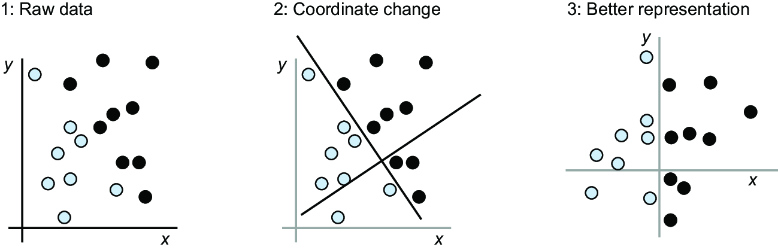
figure

Compare the original representation with a coordinate change that can make classification easier. section 1.4


How Deep Learning with R, Third Edition covers it

How deep it goes
Defines several transformation types and frames their selection as hypothesis-space search, without deriving algorithms.
Examples
Uses handwritten digits, pixel histograms, closed-loop counts, coordinate changes, projections, translations, and nonlinear selections.
What you can do after
Evaluate transformations by how well their representations support simpler rules on development data.
How it connects
Connects data transformations with machine learning, representations, feedback signals, and hypothesis spaces.

Also explained in

Compare how 20 books explain data transformation →

Related concepts

This explainer was generated by Manning's knowledge graph from the text of Deep Learning with R, Third Edition. The section links point to the parts of the book it draws on.

















