Graph machine learning learns representations or predictions from entities and relationships encoded as graphs. In transaction monitoring, nodes represent Bitcoin transactions, directed edges represent payment flows, and node embeddings combine individual features with neighborhood information. section 9.0 section 9.3.1
A practical graph-learning workflow progresses from inspection to increasingly relational models:
- Inspect and visualize licit and illicit transactions, including their feature vectors, directed edges, and class imbalance. section 9.1.4
- Train a fully connected multilayer perceptron using transaction features alone as a baseline. section 9.0 section 9.2.4
- Use graph neural networks to incorporate each transaction’s neighborhood, beginning with a graph convolutional network and then a graph attention network. section 9.0 section 9.3
Illicit Bitcoin transaction detection
Money laundering uses a web of transactions whose layering obscures the original sender and final receiver. A graph model can flag an illicit transaction using both its 165 features and its connections to surrounding licit or illicit transactions. section 9.0 section 9.1.4
Figure 9.2 Steps performed in this chapter to train AI models to fight money laundering, starting with downloading a representative dataset containing Bitcoin transactions, training a traditional deep learning model to detect illicit transactions, followed by training graph neural networks to extract further insights from the mesh of transactions in detecting money laundering.
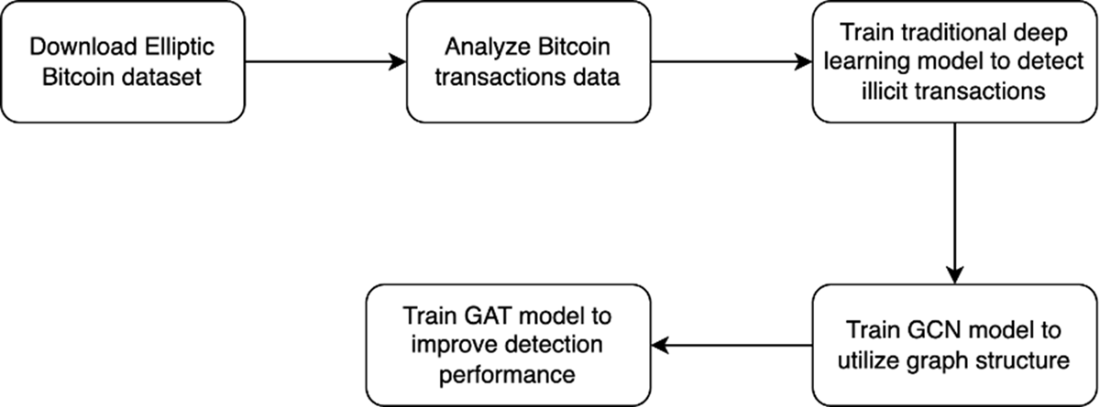
Follow the workflow from downloading and analyzing Bitcoin transactions through baseline deep learning and graph neural network models. section 9.0



