liveBook · Manning

State

As explained in Machines that Think

A computational state is a structured snapshot of the entities, relations, or conditions relevant to a task at a particular time.

A state that tracks entities and their relations over time could represent a changing situation. Neural network representations, by contrast, are recomputed from current inputs and do not persist as an independent world model. section 5.4.5

Figure 5.5 Human language refers to events and objects in the world through concepts grounded in perception, action, and consequence. Artificial neural networks instead learn patterns from indirect records of the world, such as text, images, or other data. As a result, models can generate coherent outputs by connecting representations within those records, without attaching them to a world they directly experience.
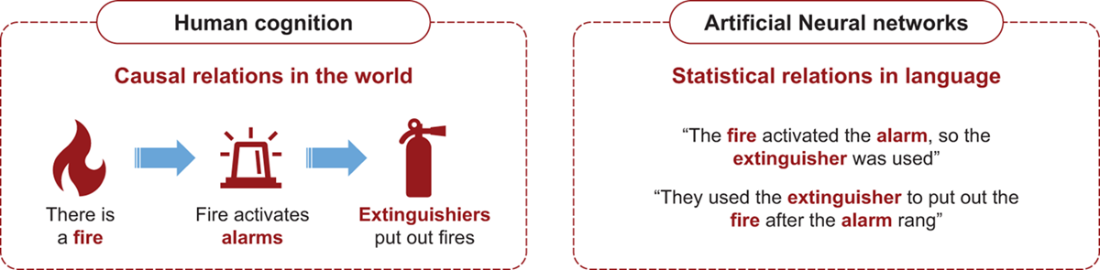
The figure contrasts human concepts grounded in perception and action with patterns learned from indirect records such as text and images. section 5.4.5


How Machines that Think covers it

How deep it goes
Traces the limitation to nonpersistent representations and identifies evolving entity relations, but does not explain an implementation.
Examples
Contrasts human concepts grounded in perception and action with patterns learned from text, images, and other indirect records.
What you can do after
Evaluate why learned representations do not by themselves constitute a persistent model of entities and their interactions.
How it connects
Connects state to world models, neural network representations, and human understanding.

Also explained in

Compare how 52 books explain state →

Related concepts

This explainer was generated by Manning's knowledge graph from the text of Machines that Think. The section links point to the parts of the book it draws on.