High availability (HA) keeps a database operating through failures by automatically failing over to redundant infrastructure. It is not the same as disaster recovery (DR), which recovers from major incidents. section 13.1 section 13.6
Keep these planning rules separate:
- Place HA replicas close together to reduce synchronization and client latency; use DR replicas across geographic locations to withstand data-center loss. section 13.1
- Do not describe a local HA topology as complete DR merely because its databases have off-site backups. section 13.1
- Match the technology to the workload and business requirement: availability groups are flexible, but failover clustering may be more appropriate for some cases. section 13.6
- Compare redundancy costs with the cost of downtime, plan capacity, and test the DR strategy rather than assuming synchronization guarantees failover. section 13.6
The same-site failover trap
Two SQL Server instances sit in separate racks in one data center and provide automatic failover through availability groups. This removes individual server, rack, and top-of-rack-switch failures, but not a site-wide outage caused by power loss, a core-network change, or a natural disaster. A geographically separate, manually failed-over topology addresses that different risk. section 13.1 section 13.6
Figure 13.1 HA topology with availability groups providing automatic failover in a single site
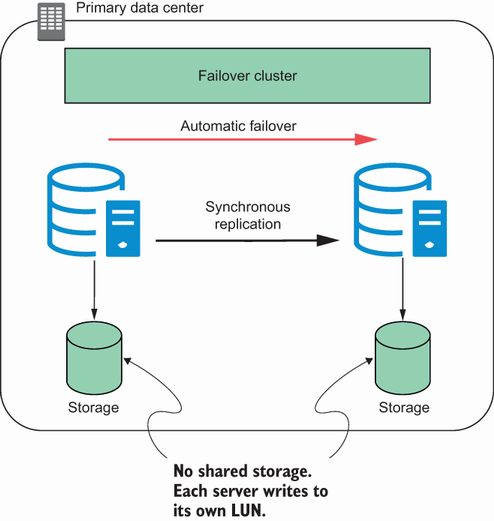
Use the topology diagram to distinguish automatic local failover from protection against a complete site failure. section 13.1



















