High availability means keeping a system online and meaningfully responsive with minimal downtime, even when errors, overload, component failures, machine crashes, or upgrades occur. section 1.1 section 1.1.1
Designing for high availability requires addressing several production concerns:
- Localize, recover from, and continue operating through unexpected errors, bugs, failed components, dropped connections, and machine crashes. section 1.1.1
- Handle increasing load by adding hardware, ideally without software changes or a system restart. section 1.1.1
- Run across multiple machines so another machine can take over and horizontal scaling remains possible. section 1.1.1
- Keep request handling responsive by preventing lengthy tasks from blocking unrelated work. section 1.1.1
- Push software updates without disconnecting established service when live updates are required. section 1.1.1
On BEAM, lightweight processes provide the main implementation mechanism. They run tasks concurrently, isolate failures, support shared-state services and background jobs, and combine with links, supervisors, and distribution to limit failures and recover the system. section 5.1 section 12.2.6
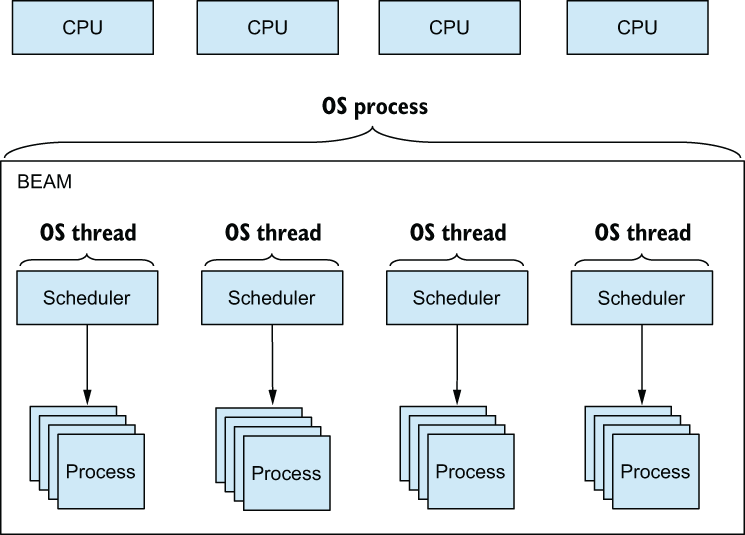
Shows how BEAM runs many lightweight processes within one operating-system process, clarifying the concurrency model behind high availability. section 5.1
A continuously available server
A production server can handle simultaneous client requests, maintain caches or session data, and run background jobs without allowing one lengthy task or failed handler to bring down unrelated work. With concurrency, distribution, process isolation, and supervision, a to-do system can degrade gracefully, recover from individual errors, and survive machine crashes. section 5.1 section 12.2.6



















