High availability keeps a lakehouse operational with minimal interruption when storage, network, service, or site components fail. It reduces single points of failure through redundancy, replication, failover, and load-balanced access while preserving continuous access for ingestion, analytics, and concurrent users. section 5.1.3 section 7.2.1
Evaluate high availability across both storage and catalog layers:
- Use active-active replication across availability zones, redundant network paths, load-balanced endpoints, or geographic distribution to tolerate localized failures. section 5.1.3
- Treat Iceberg tables as composite objects: recovering physical data files alone is insufficient when catalog metadata, manifests, snapshots, or metadata files are inconsistent. section 5.1.3
- Keep the catalog highly available because an unreachable catalog can block table queries and updates even when underlying storage remains operational. section 7.2.1
- Compare availability against consistency, latency, durability, scalability, cost, and operational burden rather than selecting a solution from availability claims alone. section 5.4 section 7.2.5
Figure 5.3 Integrity factors to consider when assessing a storage system
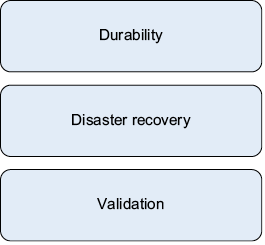
Use the integrity-factor diagram to assess availability alongside durability, consistency, recovery, and observability when selecting storage. section 5.1.3



















