Uptime describes a service remaining accessible and operational for a high proportion of the time it is needed. High availability helps limit interruptions from outages and maintenance. section 3.2.1 section 11.4.2
Azure offers different ways to reduce interruptions, depending on where a failure might occur:
- For virtual machines, availability zones place VMs in separate physical zones. Availability sets use fault domains and update domains to help limit simultaneous failures or updates. section 3.2.1
- For Cosmos DB, multi-region deployment can keep an application operating if a region goes down. Automatic failover switches to another region; zone redundancy protects against failures affecting a whole zone. section 11.4.2
A second region for an online shop
Alpaca-Ma-Bags can configure Cosmos DB with australiacentral at failover priority 0 and eastus at priority 1. If the primary region becomes unavailable, Cosmos DB can fail over to the other region. section 11.4.2 section 11.4.2
Figure 3.13 Azure availability zones with separate cooling, power, and network
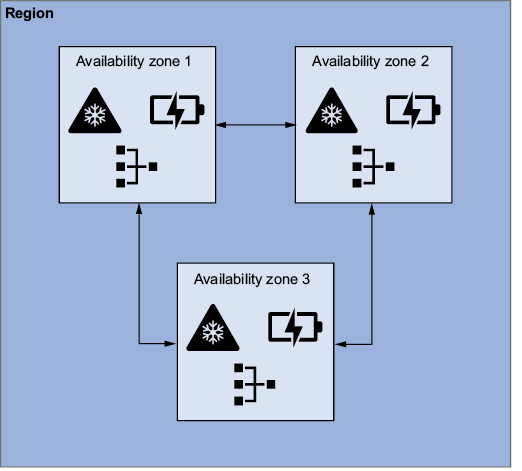
The diagram shows availability zones with separate cooling, power, and network, illustrating the physical separation behind zone redundancy. section 3.2.1



















