Metadata is structured reference data about other data or objects. In deep learning systems, it describes training runs, workflows, models, datasets, and other artifacts. Unlike service logs and metrics used for operational monitoring, it records machine learning activity so teams can compare experiments, reproduce models, and investigate degradation. section 8.2 section 8.0
A metadata and artifact store separates descriptive records from raw files. Datasets, code, processed data, and model files remain in file or cloud storage; the metadata store retains their URLs, identifiers, versions, execution IDs, facts, and lineage. Searching metadata can then reveal a model's related training inputs and outputs. section 8.1 section 8.2.1
Useful metadata categories include:
- Training-run metadata: dataset identity and version, hyperparameters, allocated and consumed hardware, code version and environment configuration, training metrics, and evaluation metrics. section 8.2.1
- General-artifact metadata: file location, version, description, and audit history. section 8.2.1
- Model-file and orchestration-workflow metadata: records that identify artifacts and connect them to the executions and workflows that produced or use them. section 8.2.1
Metadata-driven model serving
A prediction request supplies a model ID. The frontend looks up metadata containing the model version, algorithm type, and file URL; it selects a compatible predictor backend and downloads the model file to shared storage when needed. Metadata therefore connects a logical model request to its deployable artifact and serving implementation. section 7.1.2 section 7.1.3
For a complete metadata and artifact store, MLflow adds automatic logging, experiment visualization and comparison, a model registry, artifact management, reproducibility support, and deployment-oriented MLOps features. ML Metadata (MLMD) is a lightweight alternative for ingesting and searching run-based metadata within an existing artifact registry and metric-visualization system. section 8.4.3
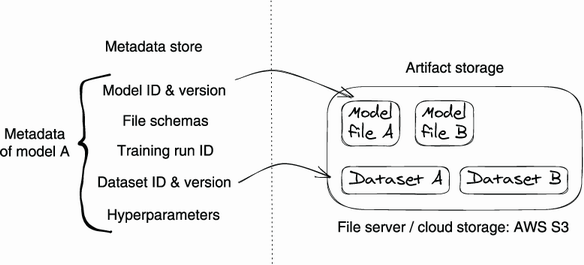
This layout shows raw artifacts in file storage associated with searchable metadata in a separate metadata store. section 8.1




















