liveBook · Manning

Metadata

As explained in Kubernetes in Action, Second Edition

Metadata is the Kubernetes object information describing an object, including identity, labels, annotations, and related attributes.

Metadata is the shared information that identifies a Kubernetes object instance. It includes details such as the object’s name, creation time, owner, and other identifying attributes. Unlike object-specific spec fields, metadata follows the same general role across object types. section 4.1.2

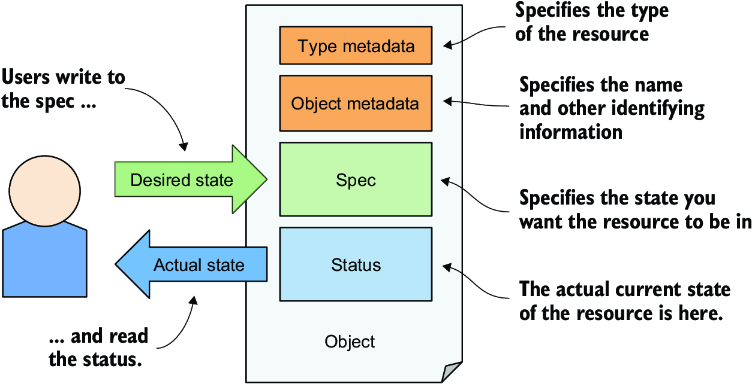
Place metadata within the larger structure of an object manifest:

  • Type metadata identifies the object type, its API group, and its API version. section 4.1.2
  • Object metadata identifies the particular instance, including its name, creation time, and owner. section 4.1.2
  • Spec describes the desired state, while status reports the current actual state; metadata provides the object information around those sections. section 4.1.2
Figure 4.3 The main sections of a Kubernetes API object
figure

Use the object-manifest diagram to distinguish type metadata and object metadata from spec and status. section 4.1.2


How Kubernetes in Action, Second Edition covers it

How deep it goes
Defines metadata and distinguishes it from spec and status, but does not enumerate a complete field reference.
Examples
Uses object manifests and identifies names, creation times, owners, and node information as concrete object details.
What you can do after
Evaluate/understand object manifests by separating identity metadata from desired and current state.
How it connects
Connects metadata with Kubernetes API objects, object manifests, spec, status, controllers, and API retrieval.

Also explained in

Compare how 21 books explain metadata →

Related concepts

This explainer was generated by Manning's knowledge graph from the text of Kubernetes in Action, Second Edition. The section links point to the parts of the book it draws on.


















