Intelligence is a capacity, or group of capacities, associated with learning, reasoning, problem solving, memory, abstraction, and adaptation. It is not directly observable: people infer it from patterns of performance, while the processes producing that performance remain partly hidden. section 9.1.2
This makes machine intelligence a question of both behavior and interpretation. A system can perform a task successfully without demonstrating how it arrived at the result or whether it understands it. Conversely, an unfamiliar mechanism or an occasional failure does not by itself rule out intelligence. section 1.5 section 9.0
Figure 9.2 Intelligence inferred from observable signs. Standard definitions describe intelligence through capacities such as deriving information, learning from experience, adapting to the environment, and using reason. These capacities are recognized through performance, while the underlying mechanism remains partly hidden.
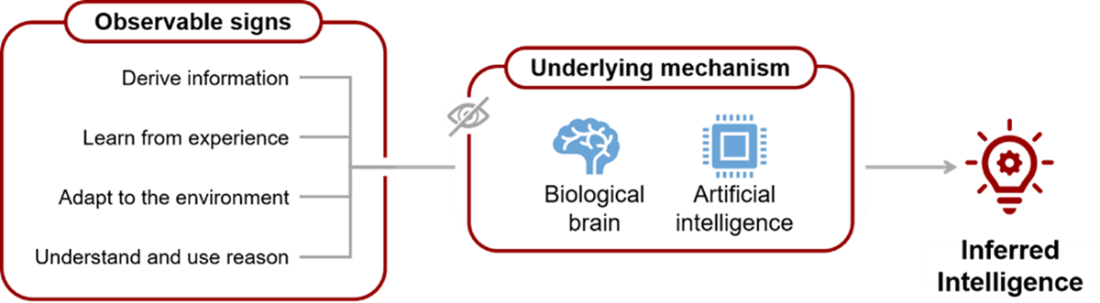
The figure distinguishes observable signs of intelligence from the partly hidden mechanisms behind them. section 9.1.2
Language is a useful window into intelligence because it lets people and machines explain, summarize, reason, and combine ideas. But it is an imperfect window. Spatial reasoning, visual imagination, motor planning, and other forms of cognition need not depend on words; fluent speech can also give an exaggerated impression of understanding. section 2.1.3 section 2.1.4
A convincing explanation
A language model may explain a medical treatment clearly and answer follow-up questions. That fluency alone does not show that it can verify its claims or judge whether they apply to a particular patient. section 1.1.3
Evaluation should also distinguish brittle performance from adaptation. A chess engine that handles unfamiliar positions demonstrates an ability to play chess, even though its processes differ from a human player's. Language models similarly adapt their responses across tasks and formats, but that flexibility leaves open what kind of understanding, if any, accompanies it. section 9.1.1
Intelligence is also distinct from agency. Artificial neural networks can produce adaptive-looking behavior toward externally supplied objectives without generating their own goals. Mistaking task-directed output for self-directed purpose can inflate expectations of autonomy and judgment. section 5.4.2
Different approaches to artificial intelligence embody different ideas about cognition: symbolic systems emphasize rules, probabilistic models address uncertainty, and learning-based systems develop behavior from data. Each expands what machines can do while exposing limits that invite a revised view of intelligence. section 1.6.1 section 1.4.5
In practical use, the distinction between performance and understanding affects trust and oversight. Capabilities deserve recognition, but consequential outputs still need evaluation in context, appropriate verification, and clear human responsibility. section 1.0 section 1.1.4






