A hidden layer is an intermediate neural-network layer whose activations are not directly observed as inputs or outputs. It receives signals from the preceding layer and passes processed signals to the next layer. section 8.2.3
Hidden layers perform the network’s internal transformation work:
- Process raw inputs through neurons, weights, bias terms, and activation functions. section 8.3.2
- Extract attributes and features that support later decision-making. section 8.2.3
- Appear in networks ranging from a few layers to hundreds, depending on the problem. section 8.2.3
- Pass information sequentially from the input layer toward the output layer during feed-forward propagation. section 8.3.2
Face identification
A face-recognition network receives images through its input layer. Hidden layers process facial attributes and features, then the output layer produces a probability that the face belongs to a particular person. section 8.3.2
Figure 8.4 A typical neural network with neurons and input, hidden, and output layers
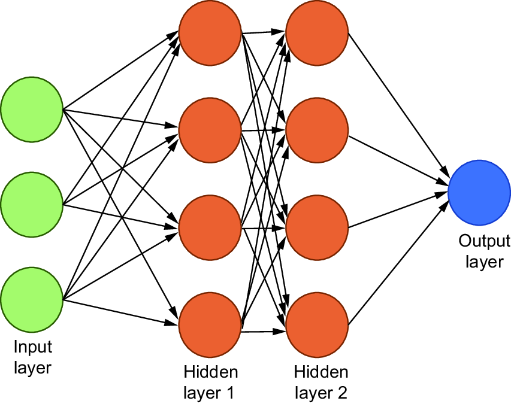
Use the network diagram to trace connections among input, hidden, and output layers. section 8.2.3







