A hidden layer sits between a neural network’s input and output layers. It helps turn input data into a prediction: the input layer receives the data, connections through the hidden layer carry learned information, and the output layer computes the result. section 3.3
The learning is stored in the weights on connections between nodes. Training starts with random weights, processes examples, compares predictions with correct labels, and adjusts the weights when predictions differ. In backpropagation, those adjustments move backward through the hidden layers. section 3.3
Following three inputs
Consider a network receiving 0.5, 0.6, and 0.2 as inputs. Each input node connects to nodes in the next layer through weighted connections. The example illustrates where a hidden layer sits; the three numbers alone do not specify what the network will predict. section 3.3
Figure 3.3 A backpropagation model with three layers
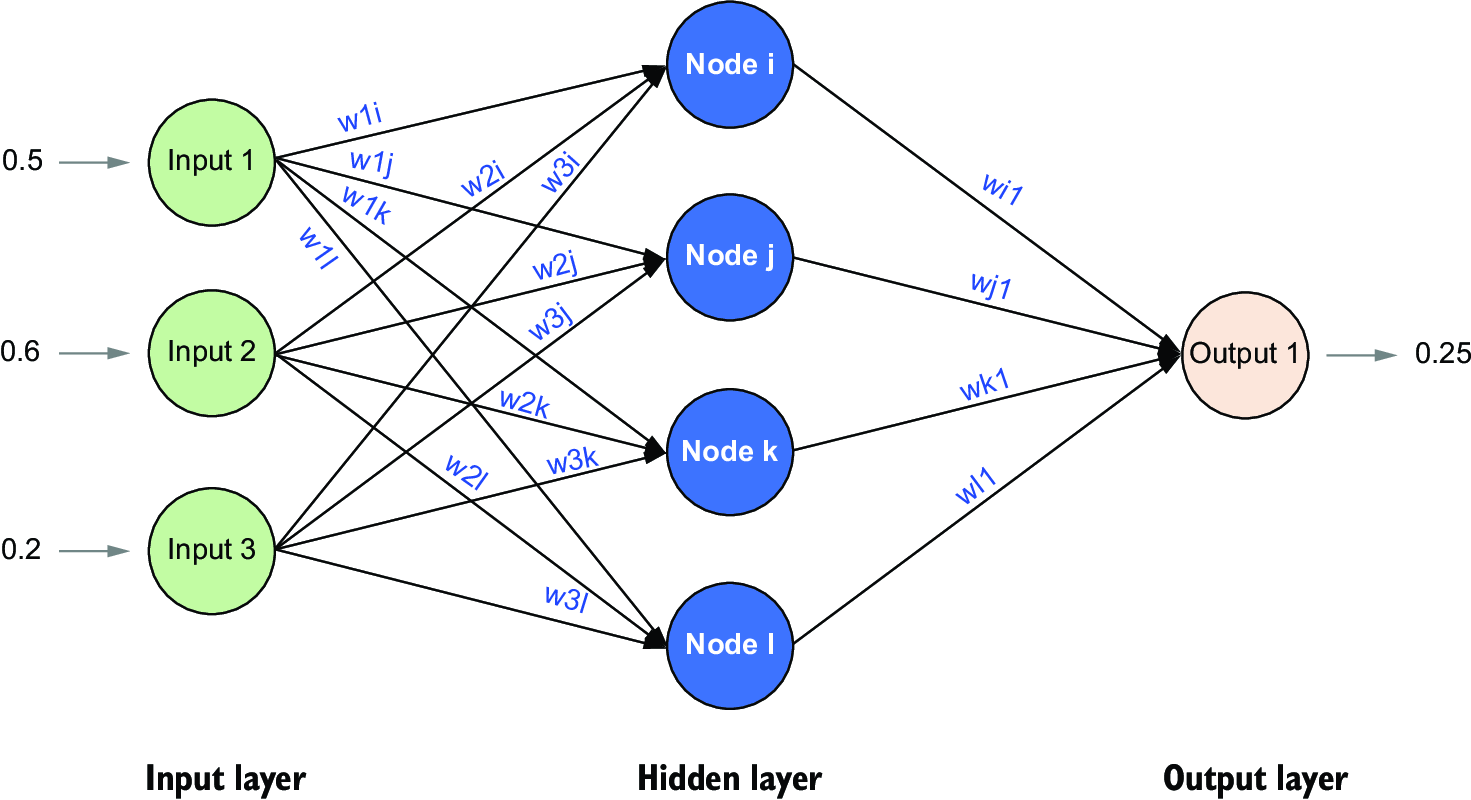
The three-layer diagram shows the hidden layer’s position between input and output. section 3.3
A network can have more than one hidden layer. Adding hidden layers is a central distinction of deep learning: successive layers can build complex concepts from simpler ones, helping the network discern characteristics in data. The number of layers describes an architecture, not a prediction of its performance on a particular task. section 3.4







