liveBook · Manning

Leaf node

As explained in Algorithms Every Programmer Should Know

A leaf node is a tree node with no children.

A leaf node is a tree node with no children. In an org chart, it is like an individual contributor with no direct reports. section 1.4.4 section 1.5

Tree types place different constraints on leaves: a full binary tree requires each node to have either zero or two children, while a perfect binary tree has all leaves at the same depth. section 1.4.4

Figure 1.8 A comparison of common binary tree structural variations. Left: A standard binary tree where nodes have a maximum of two children. Middle: A full binary tree enforcing that nodes possess either exactly zero or exactly two child nodes. Right: A highly uniform perfect binary tree where all interior nodes contain two children and every leaf node aligns at the exact same depth level.
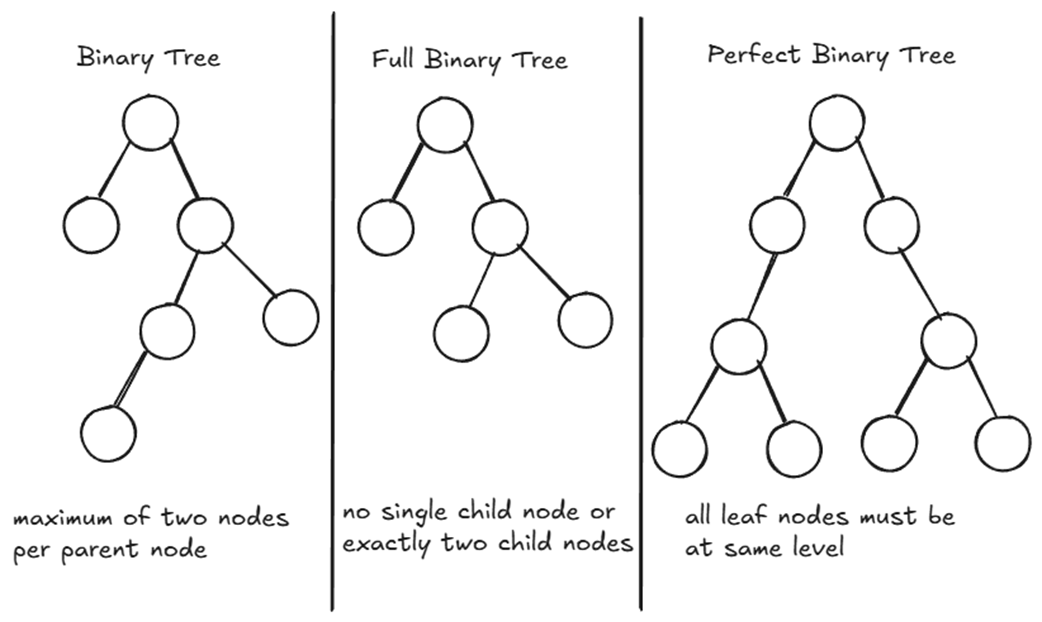
Compare how leaves appear in standard, full, and perfect binary trees. section 1.4.4


How Algorithms Every Programmer Should Know covers it

How deep it goes
Defines leaves through an org-chart analogy and distinguishes their placement in full and perfect binary trees.
Examples
Uses individual contributors with no direct reports as an org-chart example of leaves.
What you can do after
Understand tree structure by identifying nodes with no children and comparing leaf placement across tree types.
How it connects
Connects leaf nodes to trees, binary trees, full binary trees, perfect binary trees, and depth-first search.

Also explained in

Compare how 14 books explain leaf node →

Related concepts

This explainer was generated by Manning's knowledge graph from the text of Algorithms Every Programmer Should Know. The section links point to the parts of the book it draws on.











