A leaf node is a terminal node in a tree: nothing branches below it. In RAPTOR's hierarchical index, leaf nodes preserve the original text chunks and answer specific, granular questions. section 10.2 section 10.2.1
Leaf nodes serve several roles in a tree-organized retrieval system:
- Store the corpus's original text chunks at the base of the hierarchy. section 10.2
- Provide fine-grained evidence for questions about specific facts, clauses, or details. section 10.2
- Enter embedding, clustering, and summarization steps that produce higher-level summary nodes. section 10.2.1
- Complement summary nodes, enabling retrieval to move between granular evidence and broad themes. section 10.0
Specific contract evidence
For the question “What is the specific termination fee in the contract?”, retrieval can match a leaf containing the relevant text chunk. A broader question about termination conditions can instead match a summary node above it. section 10.2
Figure 10.2 Recursion.
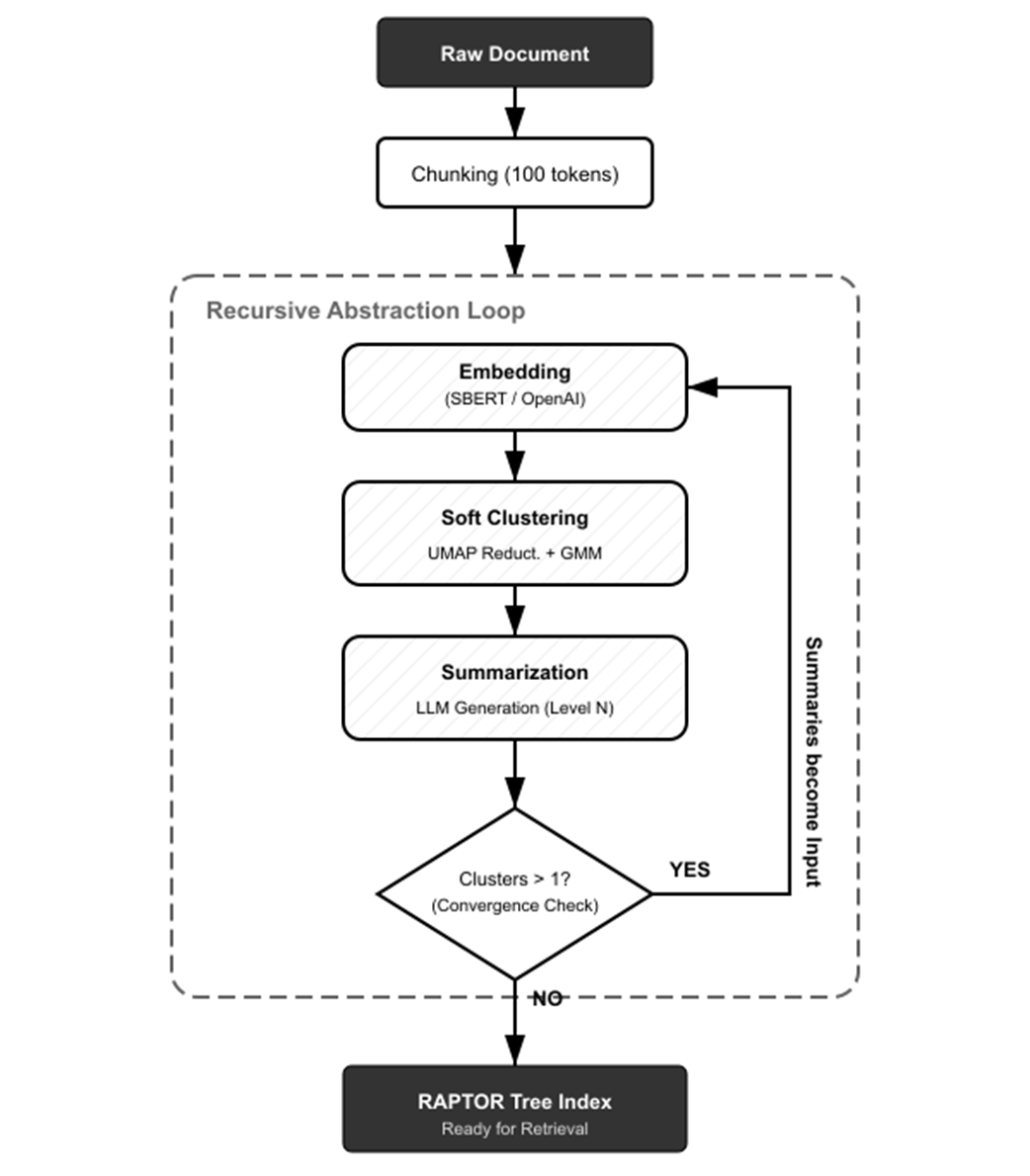
Shows how short leaf chunks flow through embedding, clustering, and recursive summarization to form higher tree levels. section 10.2.1













