A leaf node ends a path through a decision tree. In a predictive tree, it contains the model’s final prediction; in a decision tree for choices under uncertainty, the terminal node records the outcome of an action and uncertain event, such as a utility, payoff, or loss. section 7.1.2 section 5.3.1
Each root-to-leaf path gathers the decisions or events along the way. In a predictive tree, those decisions partition observations until a prediction is assigned. In a choice tree, branches lead through actions and uncertain events to outcomes that can be compared using expected utility. section 7.1.2 section 5.3.1
Figure 7.1 Decision tree for the treatment decision. The square node represents the choice between treating and not treating. Each action leads to a circular chance node representing whether disease is present (𝑝 = 0.09) or absent (𝑝 = 0.91). The terminal branches show the four possible outcomes and their assigned utilities. Rolling the tree back combines the probabilities and utilities to produce expected utilities of −0.1 for treating and 91 for not treating, making the latter the preferred action.
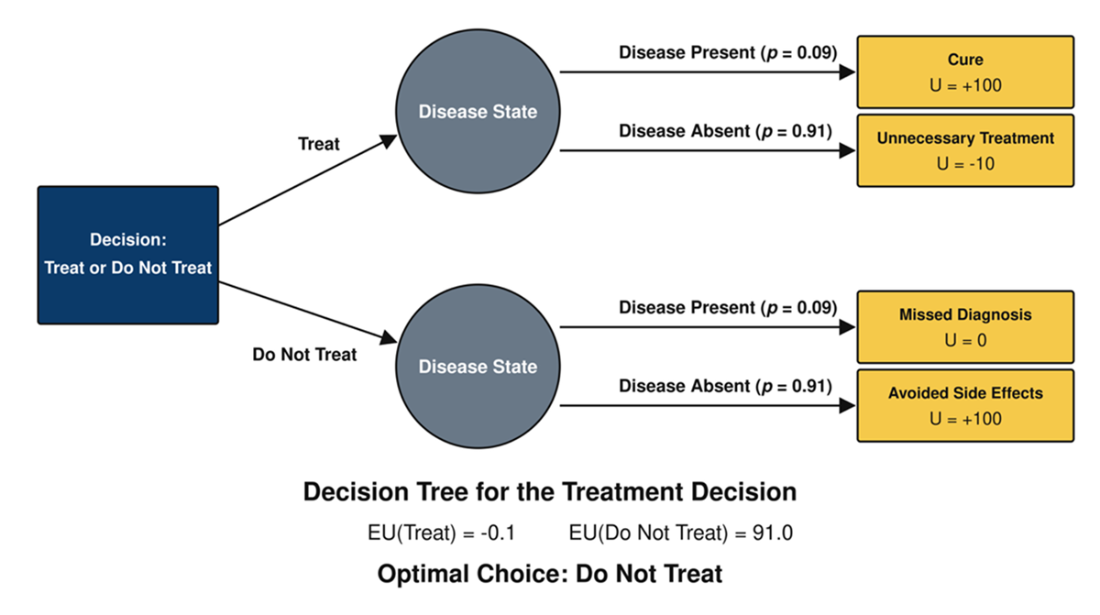
The treatment decision tree shows four terminal outcomes, each assigned a utility, after the choice to treat or not and the uncertainty about disease. section 7.1.2













