MLOps (machine learning operations) is the practice of assembling the tools and processes needed to move deep learning work from experimentation into dependable product delivery. It addresses the repeated effort of separately combining training, serving, experiment tracking, and performance-tracking capabilities for each application. Its aim is a consistent way to deliver deep learning features quickly and reliably as applications and quality expectations grow. section 1.1
MLOps belongs in a larger development cycle that aligns data scientists, engineers, product owners, and other stakeholders around a business need. Before costly production work begins, the proposed algorithms and data should be vetted with the product team or customer. This reduces late rework and ensures that production investment supports a real product requirement. section 1.1 section 1.1.1
Figure 1.1 A typical scenario to bring deep learning from research to a product. We call this the deep learning development cycle.
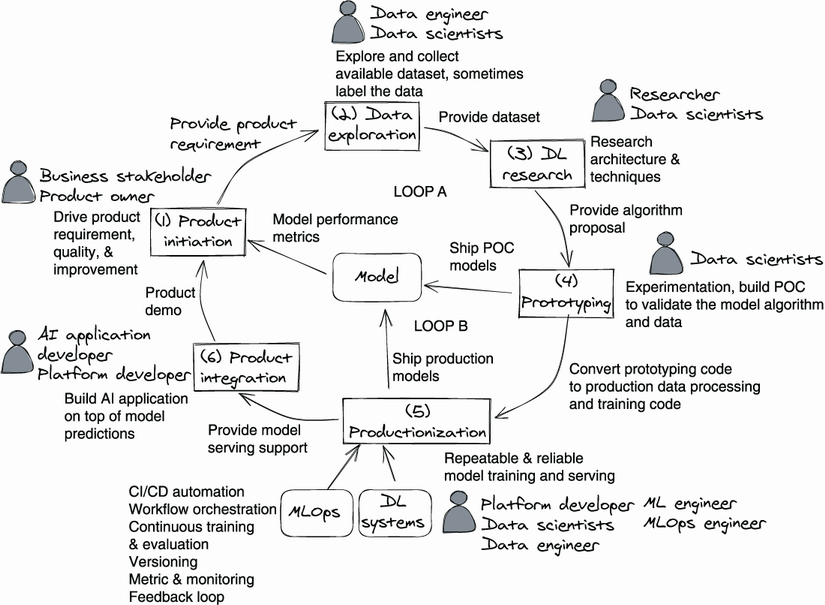
This workflow view situates MLOps in the path from research activity to a product, rather than treating it as an isolated tooling task. section 1.1
Productionization is the MLOps phase: making a model-based product ready for users. Production-worthy systems serve customer requests, tolerate expected load, and handle adverse conditions such as malformed input or request overload gracefully. The work continues after release through model-metric monitoring, evaluation, feedback gathering, and retraining. section 1.1.1
A productionization effort can include:
- Build recurring data pipelines that collect from multiple sources while keeping datasets versioned and current. section 1.1.1
- Preprocess and enrich data, including integration with external labeling tools when needed. section 1.1.1
- Refactor prototype code and containerize it as production-quality training code. section 1.1.1
- Make training and serving reproducible by versioning and tracking their inputs and outputs. section 1.1.1
- Record training metadata such as time, duration, and hyperparameters, plus model metadata such as metrics and the data and code used, to trace each trained model. section 1.1.1
Figure 1.2 MLOps applies DevOps approaches to deep learning for the productionization phase, when models get shipped to production. (Source: Machine Learning Engineering in Action, by Ben Wilson, Manning, 2022, figure 2.7)
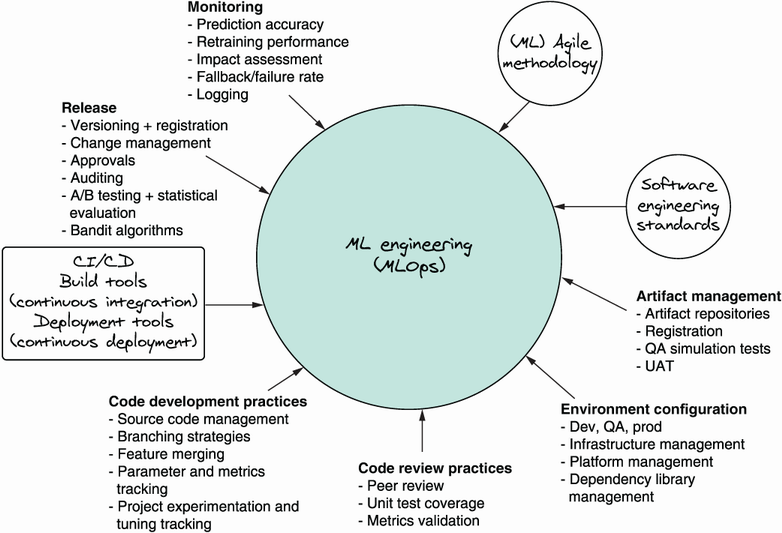
This diagram frames MLOps as applying DevOps approaches during productionization, when deep learning models are shipped to production. section 1.1.1
From prototype to traceable service
A team first validates that a proposed model and dataset address a product need. It then replaces one-off prototype work with repeatable data and training pipelines, records the data, code, hyperparameters, and metrics behind each model, and operates the released model under request load while monitoring outcomes and gathering feedback for retraining. section 1.1.1






