MLOps is the practical discipline of reliably deploying and maintaining machine-learning systems in production. It spans the full life cycle: acquiring data, training models, monitoring behavior, and eventually terminating systems. Reliable operation depends on orchestration, versioning, feedback loops, CI/CD, security, resource provisioning, and data governance. section 3.1
Infrastructure is the how; the machine-learning life cycle is the why. A small system may run from one data scientist’s laptop, but large language models require sturdier infrastructure because models may exceed local storage or GPU capacity. LLMOps therefore extends MLOps challenges rather than clearly replacing MLOps as a separate discipline. section 3.1 section 3.4
A production-oriented MLOps platform commonly combines:
- Data stores for storing, governing, and securing data, ranging from databases and warehouses to lakes and meshes. section 3.4.1
- Orchestrators such as Airflow, Prefect, and Mage for automating multistep workflows across resources and services. section 3.4.1
- Pipelines for moving and cleaning data, scheduling training jobs, running batch inference, and loading results. section 3.4.1
- Container registries for consistent execution, with streaming integrations added when processing needs require them. section 3.4.1
- Compression and distributed computing for making oversized models smaller and executable across multiple resources. section 3.3
From laptop prototype to production platform
A scikit-learn model running on one data scientist’s laptop can work as a scrappy prototype. An LLM-oriented platform must instead coordinate data stores, pipelines, containers, GPUs, and other infrastructure around the model life cycle. section 3.4
Figure 3.7 A high level view of an MLOps infrastructure with LLMs in mind. This diagram attempts to cover the full picture and the complexity of the many tools involved to make ML models work in production.
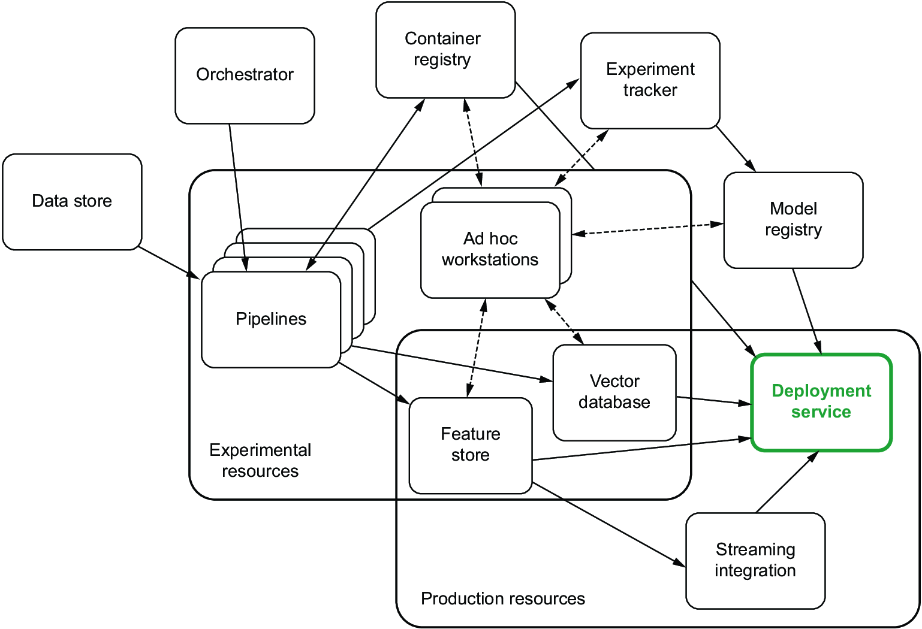
Use the infrastructure overview to inspect how data stores, orchestrators, pipelines, containers, and model-serving components fit together in an LLM-oriented MLOps system. section 3.4






