MLOps is the iterative practice of developing, deploying, monitoring, and improving machine-learning systems. A trained model is one artifact in a larger loop: production value also depends on dependable data, repeatable workflows, and a way to respond when conditions change. section 2.6 section 2.0
Build the loop around the problem, not just the training run:
- Define the business problem and agree on requirements and evaluation criteria with stakeholders. “Predict customer churn” alone is too vague to guide a model. section 2.1
- Collect and prepare data, then track data, code, configurations, and model artifacts so experiments and releases can be reproduced. section 1.5 section 2.3
- Automate connected stages such as preprocessing, training, validation, and deployment. In Kubeflow Pipelines, components can pass data to downstream components. section 1.3.3 section 2.3
- Monitor the deployed model and revisit earlier stages when performance or requirements change. A weak training result may call for different data preparation, not merely another deployment. section 1.4.1 section 2.4
A model that must keep changing
A used-car dealership deploys a price-prediction model. Customer needs and market conditions change; commercial vehicles may later require another model version. A workflow for building, testing, and deploying versions lets the team make those changes while retaining model and code lineage. section 2.1
MLOps shares automation, testing, deployment, and collaboration practices with DevOps, but gives data and models their own life cycles. Retraining can change a model without changing application code. Experiment tracking, model versioning, interpretability, bias, and monitoring therefore need explicit attention. section 2.4
Figure 2.2 ML as a loop
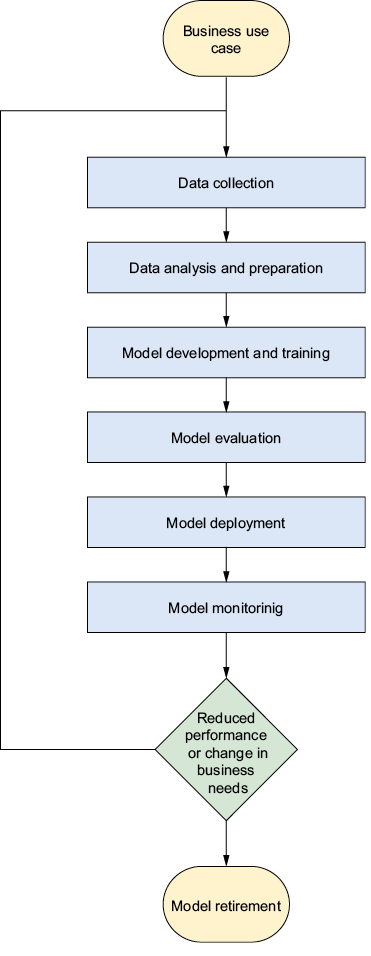
Use the loop diagram to locate feedback from deployed behavior and changing requirements within the continuing ML workflow. section 2.1
Choose tools for the job they perform rather than treating one stack as mandatory: Kubeflow Pipelines connects workflow stages, MLflow supports model management, and Feast manages reusable features for training and serving. Test a candidate tool against the use case early; a tool that fits one data-drift problem may not fit another. section 1.5 section 1.3.2






