liveBook · Manning

Drift

As explained in Kafka for Architects

Configuration drift is the divergence between a system's actual configuration and its declared desired configuration.

Configuration drift is the divergence between a Kafka cluster’s actual configuration and its desired configuration declared in Git. A validation pipeline can detect discrepancies, warn about them, and suggest corrective changes; it cannot prevent authorized users from making direct changes. section 10.2.2

A manually created topic

An authorized user creates a Kafka topic outside the Git workflow. A periodic validation pipeline detects the difference from the declared Git state and can recommend reconciliation. section 10.2.2

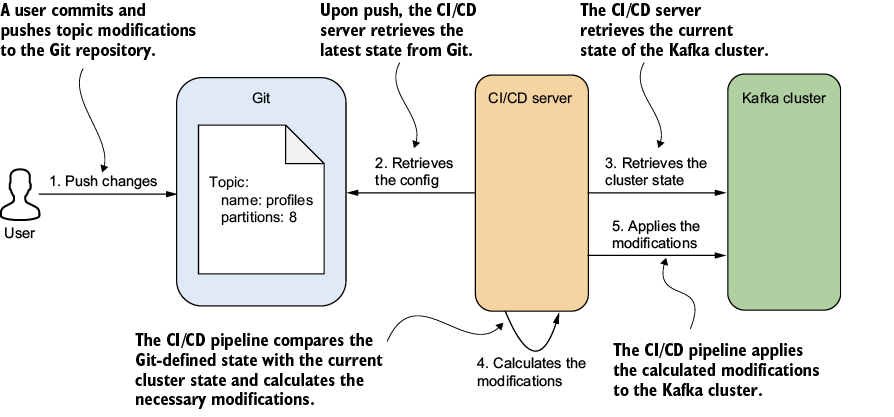
Figure 10.1 Applying Kafka cluster modifications via GitOps: after the updated Kafka cluster configuration is pushed, the CI/CD pipeline retrieves the current cluster state, calculates the required modifications, and applies them.
A screenshot of a computer

AI-generated content may be incorrect.

Shows a CI/CD pipeline comparing the Kafka cluster’s current state with its Git-declared configuration and applying necessary changes. section 10.2.2


How Kafka for Architects covers it

How deep it goes
Defines drift and describes detection, warnings, and corrective suggestions, but notes that authorized direct changes cannot be prevented.
Examples
Uses an authorized user creating a topic directly as an example of a change that can cause drift.
What you can do after
Operate Kafka configuration through Git-driven comparison, reconciliation, and periodic drift validation.
How it connects
Connects GitOps, Git, and CI/CD pipelines with Kafka configuration management.

Also explained in

Compare how 12 books explain drift →

Related concepts

This explainer was generated by Manning's knowledge graph from the text of Kafka for Architects. The section links point to the parts of the book it draws on.









