Drift is a difference between a desired state and what is actually deployed. For API gateway configuration, the desired state is declared in an environment repository, while the actual state is the configuration running in an environment. A direct change through the gateway UI can create drift; so can an intentional repository change that has not yet reached the gateway. section 1.5.6
Continuous reconciliation turns that difference into an operational workflow:
- Keep the desired configuration in Git. Make changes through pull requests so they can be reviewed and audited, rather than editing the gateway directly. section 1.5.6 section 9.4.1
- Have a software agent compare the deployed configuration with the repository. When it detects drift, it can raise an alert and attempt to update the deployed state to match. section 1.5.6 section 9.4.1
- If a repository change must be undone, revert it in Git so the recorded desired state changes too. section 1.5.6
A gateway changed outside Git
Suppose someone changes an API gateway setting in its admin UI but leaves the environment repository unchanged. The deployed setting now differs from the desired setting. A reconciling agent detects the divergence and attempts to restore the repository-defined configuration. To make the change persist, propose it through the Git workflow instead. section 1.5.6 section 9.4.1
A related form of API drift concerns behavior rather than gateway configuration: a live endpoint can disagree with its published OpenAPI definition. For example, a response may omit a field the API reference marks mandatory. Manual translation from the definition into controller code, or a code change not reflected in the definition, can cause this mismatch. Updating the OpenAPI definition when requirements change and generating a controller stub from it helps keep implementation and reference aligned; gateway reconciliation addresses a different desired-versus-deployed difference. section 6.1 section 1.5.6
Figure 1.4 APIOps is based on the GitOps approach of having the desired configuration state of the API gateway, and services are defined declaratively in an environment repository in Git. Dev teams make all changes to the desired system state via Git, and operations teams can review and approve. Software agents automatically detect any difference between the deployed state and the desired state (as defined in the environment repository). If the agent detects a drift, it automatically deploys the desired state to the specified environment so the actual state matches.
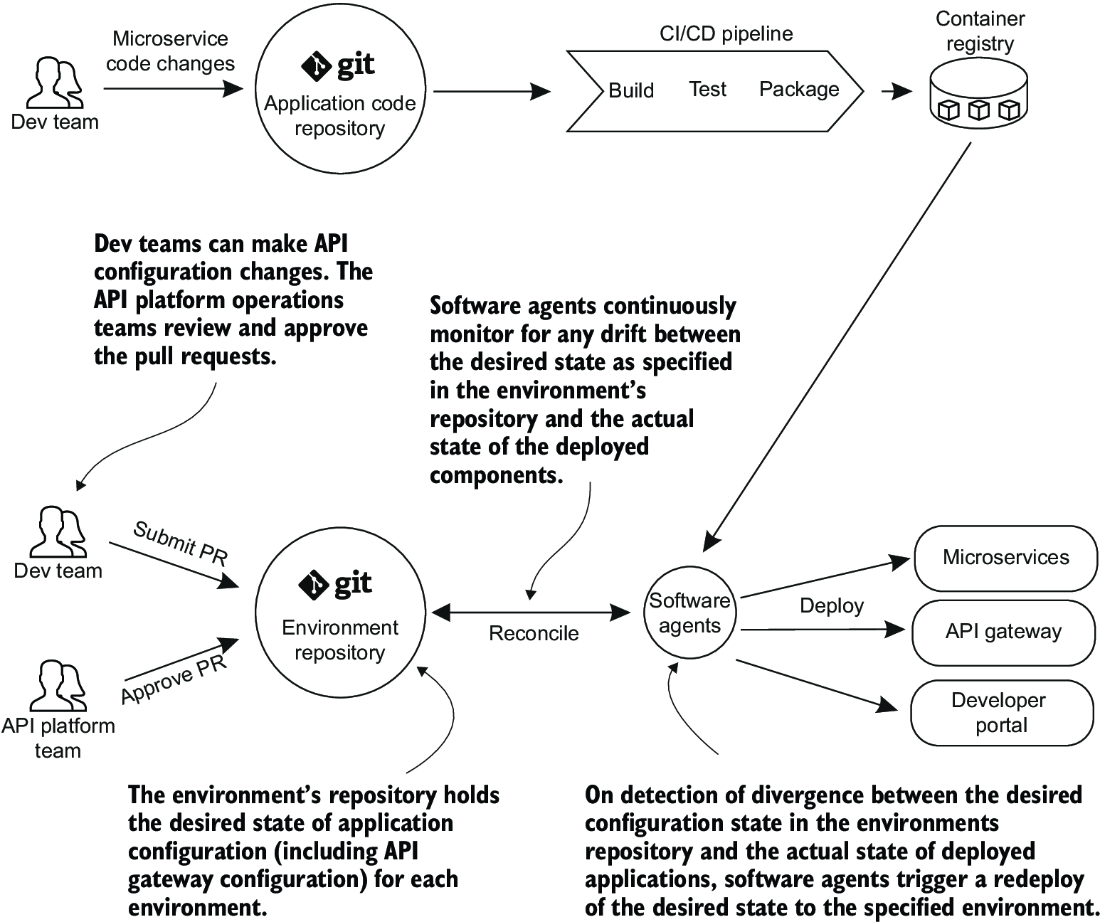
Follow the path from the Git environment repository to the deployed API gateway: the agent detects a difference and deploys the desired state to close it. section 1.5.6











