Multifactor authentication (MFA) verifies identity with authentication factors from multiple categories before granting access. It reduces the risk of account compromise because learning one factor does not provide sufficient access. section 11.3.2
Classify authentication factors by what the user knows, possesses, or physically is:
- Knowledge — something you know, such as a password, PIN, or security question and answer. section 11.3.2
- Possession — something you have, such as an identification badge, smartphone, SMS-enabled phone, or authenticator app. section 11.3.2
- Inherence — something you are, such as a facial, palm, fingerprint, or retinal biometric. section 11.3.2
Recognizing true MFA
A password and PIN do not constitute MFA because both are knowledge factors. Touching an access badge and scanning a fingerprint does qualify because possession and inherence are combined. Likewise, a username/password login followed by an SMS code combines knowledge with possession of the phone. section 11.3.2 section 11.5.2
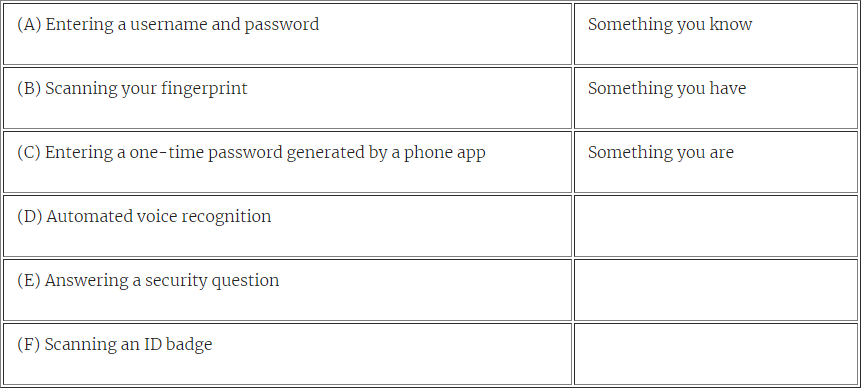
Use the factor-classification figure to practice mapping authentication methods to knowledge, possession, and inherence. section 11.5.2








