A neural network’s architecture describes how its nodes are arranged and connected. Nodes are grouped into an input layer, one or more hidden layers, and an output layer; each layer connects to the non-bias nodes in the next. section 10.1
Figure 10.14 The general architecture of a neural network. The nodes are divided into layers, where the leftmost layer is the input layer, the rightmost layer is the output layer, and all the layers in between are hidden layers. All the nodes in a layer are connected to all the (non-bias) nodes in the next layer.
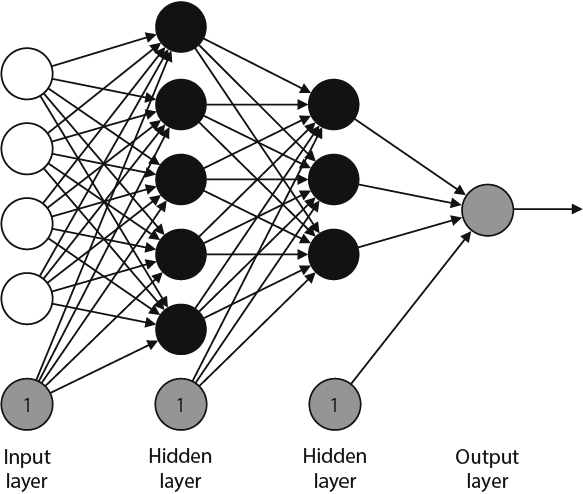
See the layer layout and the connections between successive layers. section 10.1
Each node acts as a classifier: it combines its inputs and bias, then applies an activation function. Later layers combine earlier classifiers’ outputs, allowing the network to form more complex decision boundaries than a single linear classifier. section 10.1 section 10.1
Classifying alien moods
A single line cannot separate happy and sad aliens based on counts of “aack” and “beep.” Combining two line-based classifiers with an output classifier separates the examples, illustrating how connected perceptrons form a network. section 10.1 section 10.1












