liveBook · Manning

Quantitative data

As explained in Data Without Labels

Quantitative data consists of values that can be measured, weighed, scaled, recorded, and subjected to mathematical operations.

Quantitative data consists of values that can be measured, weighed, scaled, or recorded. It supports mathematical and statistical operations and commonly represents business measures. section 1.2.2

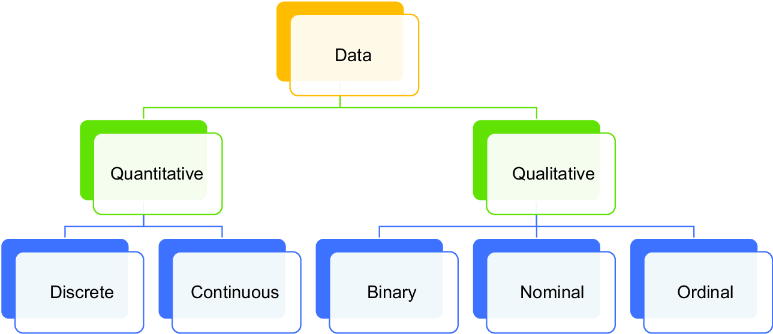
Classify quantitative values as:

  • Discrete data: precise integer counts, such as passengers on a plane or a city's population. section 1.2.2
  • Continuous data: values within a range that can include decimals, such as height or product price. section 1.2.2

Retail transactions

A structured retail dataset can record customer ID, transaction date, amount spent, number of items, payment mode, and city. Amount and item count are quantitative attributes; payment mode and city are categorical. section 1.2.2

Figure 1.2 The divisions and subdivisions of data
figure

Use the data-classification figure to compare quantitative data with qualitative, structured, and unstructured data. section 1.2.2


How Data Without Labels covers it

How deep it goes
Defines quantitative data and distinguishes discrete integer values from continuous values that may include decimals.
Examples
Uses height, revenue, customer counts, demand quantity, area, volume, and retail transaction amounts as examples.
What you can do after
Evaluate values by identifying whether they are quantitative, discrete, or continuous.
How it connects
Connects quantitative data with qualitative data, discrete data, continuous data, structured data, and unstructured data.

Also explained in

Compare how 7 books explain quantitative data →

Related concepts

This explainer was generated by Manning's knowledge graph from the text of Data Without Labels. The section links point to the parts of the book it draws on.




