Quantitative data records amounts, counts, or measurements as numbers. In a table, it commonly appears as a numeric feature: integers can represent counts, while floating-point values can represent measurements. A continuous column specifically contains real-number values, such as units per US dollar or daily sales income. section 1.1 section 2.1.2
Interpret the meaning of the scale, not just its storage type. Ratio-scale values such as unit sales or money have a real zero and are positive; interval-scale values such as Celsius or Fahrenheit have an arbitrary zero and can be negative. Integer-valued columns may also encode ordinal ranks or categories, so numeric-looking values require inspection before modeling. section 2.1.2
Check a candidate quantitative column before using it as a model feature:
- Confirm that values are actually numeric rather than strings that merely look numeric. section 9.1
- Use descriptive statistics to inspect distribution, central tendency, and spread for numeric DataFrame columns. section 9.1
- Use unique-value counts as a clue: many distinct values may suggest continuous treatment, while few often suggest categories; treat this as a heuristic, not a rule. section 9.1
- Check missing values and clean or transform values before training; deep learning models require missing values to be filled or records removed. section 9.6
Preparing real-estate price values
A Price field can look quantitative while still needing preparation. Remove rows with a missing target price, remove the RM currency marker, strip commas, and convert the remaining strings to numeric values. The result is a valid numeric target column for a model. section 9.2.2
Figure 9.3 Output of describe() for this dataset
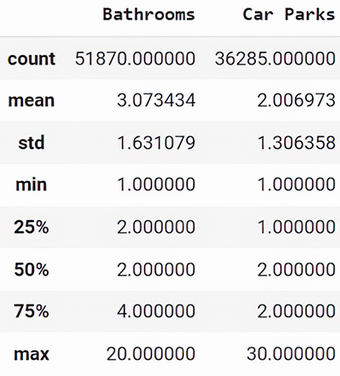
Use the descriptive-statistics output to verify which apparent numeric columns are genuinely numeric and to inspect their distributions. section 9.1
After numeric values are valid, preserve their usefulness through appropriate preprocessing. Normalize continuous columns when consistent ranges are needed, and separate mixed-content fields into distinct, single-kind features so each can be used for training. section 9.6






