Planning organizes dependent actions into an ordered sequence that moves an agent from a goal to an outcome. It connects reasoning, tool use, evaluation, and feedback: the agent derives a plan, executes tasks, checks results, and can revise its course. section 10.2 section 11.7
A sequential planner typically follows these steps:
- Define the goal and select the available actions or tools. section 11.3
- Ask an LLM to produce a short, structured plan whose subtasks use only those actions. section 11.3
- Parse the plan and execute its subtasks locally, passing earlier results through the execution context. section 11.3
- Return results to the LLM for evaluation and summarization, then produce the final user-facing output. section 11.3
- Add feedback when results require correction, replanning, or adjustment of later tasks. section 1.3 section 11.4
Research and save a Wikipedia summary
Given a goal such as retrieving information about a topic and saving it to a file, the planner can sequence search_wikipedia, get_wikipedia_page, summarization, and save_file. Each later task can use the preceding result; an added summary task can use the assistant’s capabilities even without a dedicated function. section 11.2 section 11.6
Figure 11.7 The planning process for creating and executing a plan
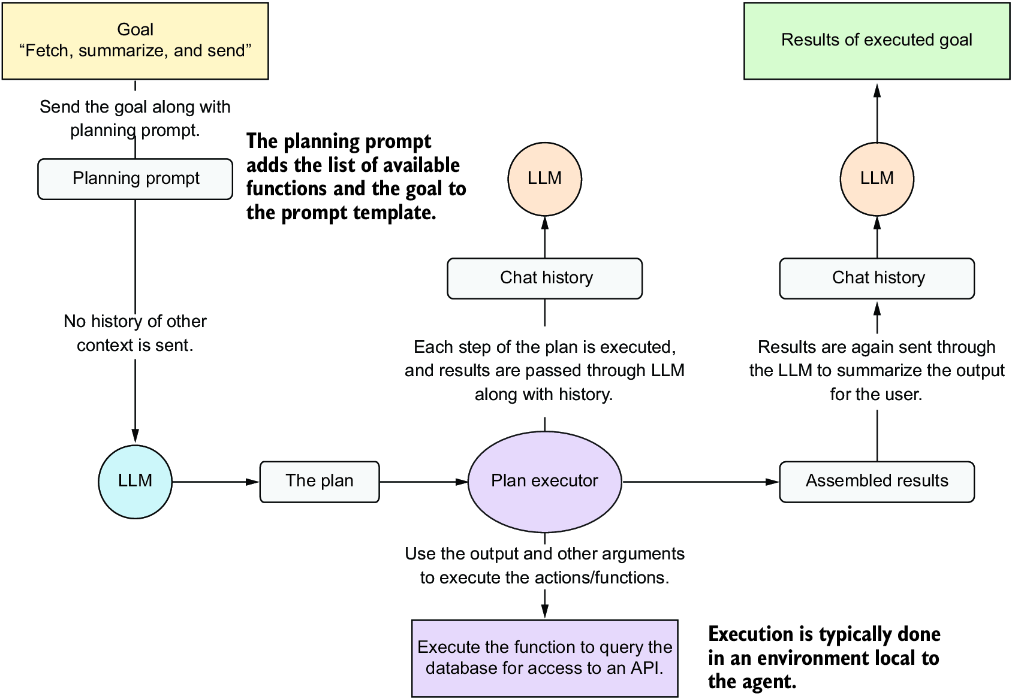
Trace the complete planning loop from constructing a prompt through plan execution and returning results. section 11.3





