Planning computes the next action or action sequence that moves a robot toward an objective using information about the robot and its environment. section 1.2.4 section 1.5
A robot separates planning from sensing by treating objective-driven decisions as planning. Sensing extracts meaningful state from raw sensor data; acting turns planned commands into physical actions. section 1.2 section 1.2.3
Planning changes shape with the robot and objective:
- Industrial manipulator: calculate joint positions that move a gripper through intermediate poses toward a target pose. section 1.2.4
- Quadcopter: calculate a collision-free exploratory path, then initiate landing when a yellow H is detected. section 1.2.4
- Mobile robot fleet: assign transport tasks, derive paths through a graph, and send each robot’s path for execution. section 1.2.4
Planning inside the robot loop
A minimal control loop repeatedly obtains state, plans an action, and executes it: while True: state = sense() action = plan(state) act(action) Each iteration can produce a different result because sensing and acting interact with changing robot and environmental states. section 1.2.1
Figure 1.1 The conceptual structure of a robot system forms a continuous loop across six essential parts. Sensors acquire raw data from the environment, which sensing processes into meaningful information. Planning uses this information to calculate the next action, which acting translates into physical commands for actuators that ultimately alter the environment.
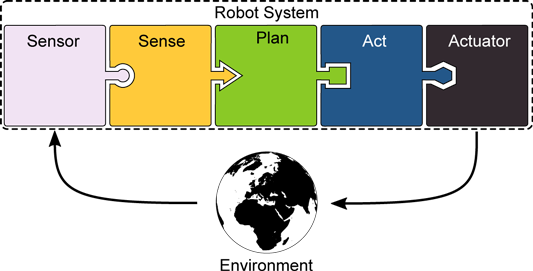
Use the system loop to trace information from environment and sensors through sensing and planning into acting and actuators. section 1.2










