A propensity score summarizes how likely a subject is to receive a treatment given observed confounders. Traditionally, it is the conditional treatment probability, often fitted with logistic regression. More broadly, a learned function can compress the confounders’ influence while making them conditionally independent of treatment. section 11.4.2
Figure 11.10 The propensity score is a compression of the causal influence of the common causes in the backdoor adjustment set.
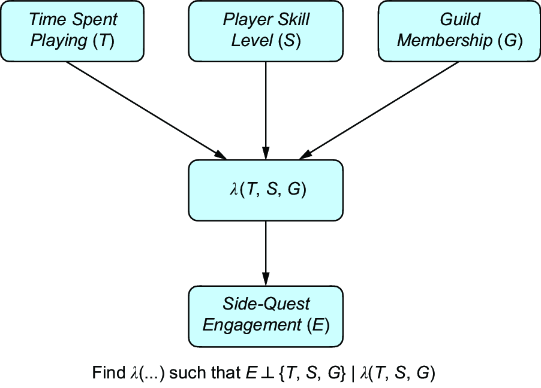
The figure visualizes propensity scores as a compression of common causes in a backdoor adjustment set. section 11.4.2
Use the score to reduce adjustment over many confounders when estimating a backdoor causal effect:
- Stratification groups observations into propensity-score subsets and adjusts across the resulting strata. section 11.4.2
- Matching pairs individuals with similar propensity scores before comparing treatment outcomes. section 11.4.2
- Weighting applies inverse-probability weights to construct the causal comparison. section 11.4.2
Online gaming treatment model
For high Side-Quest Engagement, estimate each player’s propensity from Guild Membership, Time Spent Playing, and Player Skill Level. DoWhy can then estimate an ATE using propensity-score stratification, matching, or weighting. section 11.4.2 section 11.7

