A recommender system suggests items or actions using information about users and available items. Streaming services, online stores, and autocomplete systems use recommendations to help people choose among many possibilities. section 3.3.1
Prediction alone does not show that a recommendation changes behavior. A system might accurately predict a customer’s next purchase even when the customer would have made that purchase without the recommendation. section 3.3.1
The bread-purchase test
A customer buys bread every Monday, Wednesday, and Friday. Predicting the next purchase can reach 100% accuracy, yet the recommendation may have no influence. Compare users who receive recommendations with users who do not using an A/B test. section 3.3.1
Figure 3.12 Graph of a pure recommender system that does not influence the customer. This system may predict customer behavior accurately, but it does not affect their actions.
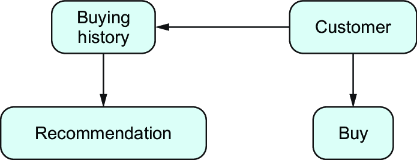
Use the causal graph to distinguish accurate prediction from an actual effect on customer behavior. section 3.3.1
Figure 3.13 Standard graph of a recommender system. The key feature here is the arrow from Historical Purchases to Recommendations, representing the recommender’s function.
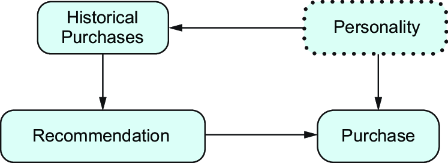
Use the standard graph to trace how historical purchases inform recommendations. section 3.3.1







