A recommender system suggests items to users by predicting what they may watch, listen to, click, or buy. It can predict a quantity, such as listening time or spending, or classify whether a user will take an action. section 3.8 section 5.5
Two approaches shown here are:
- Use regression to predict a quantity associated with user interest, using demographic or behavioral features. section 3.8
- Use classification to predict a yes-or-no action, such as clicking a video or buying a product. section 5.5
Recommend an app
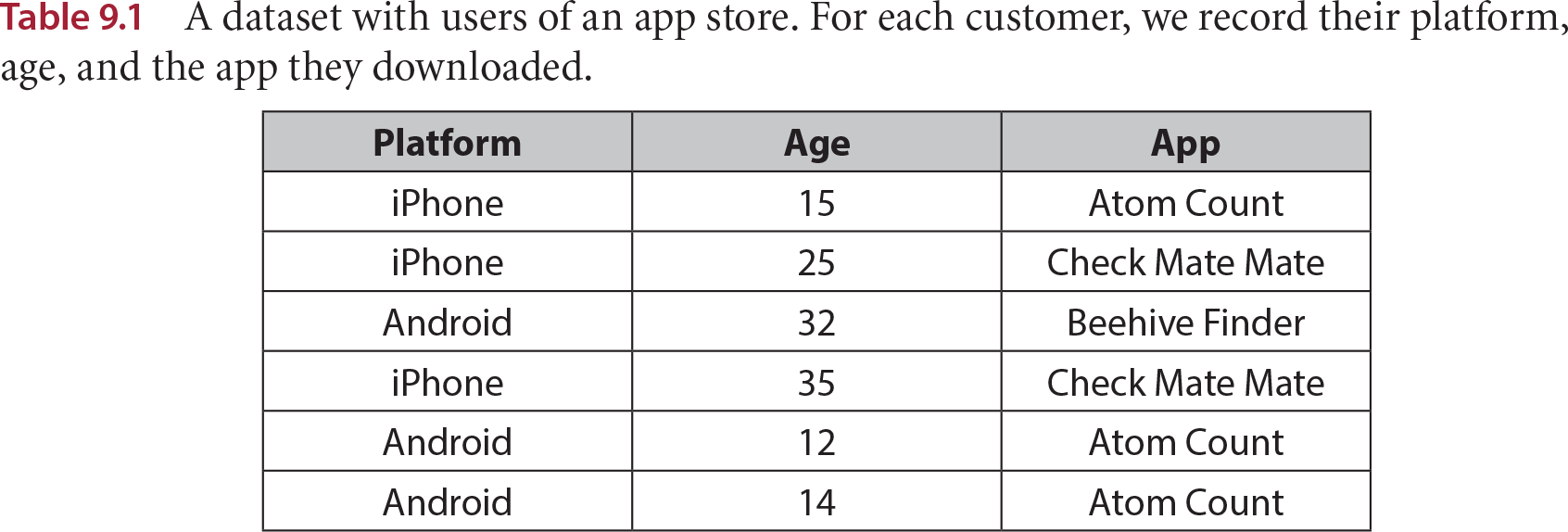
A small dataset records users’ platform, age, and downloaded app. A decision tree can ask which feature best separates the app choices, then repeat that process within each group. In this example, age makes a better first split than platform; adding a platform split can correctly predict every example in the dataset. section 9.1 section 9.2
Table 9.1 A dataset with users of an app store. For each customer, we record their platform, age, and the app they downloaded. (view table figure)
| Platform |
Age |
App |
| iPhone |
15 |
Atom Count |
| iPhone |
25 |
Check Mate Mate |
| Android |
32 |
Beehive Finder |
| iPhone |
35 |
Check Mate Mate |
| Android |
12 |
Atom Count |
| Android |
14 |
Atom Count |
Inspect the sample data used to illustrate app recommendations from platform and age. section 9.1