Risk management treats software design as a process of identifying problems, weighing their costs, and choosing compromises among goals, requirements, simplicity, and quality attributes. section 1.2.1
Typical risks that shape design decisions include:
- Low budget can limit access to experienced architecture and reduce production quality. section 1.2.1
- Changing or misunderstood requirements can make an initially adequate system or feature unusable. section 1.2.1
- New requirements, limited time, and overcomplicated code can create redesign, discarded implementation, and maintenance costs. section 1.2.1
Scaling beyond the requirement
A system designed to serve a thousand clients may face severe problems when popularity brings millions. The original capacity requirement was met, but changing demand exposes a design risk. section 1.2.1
Figure 1.4 Compromising between simplicity, goals, and requirements
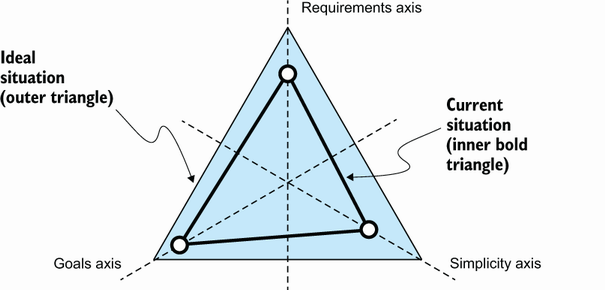
Use the radar chart to compare progress toward goals and requirements while making trade-offs with simplicity and cost. section 1.2.1




