A link goes viral, and traffic jumps from 10 users a minute to 10,000 users a second. Can the system handle the rush without crushing itself under its own success? Scalability is the ability to handle increasing workloads, including by adding resources. It is a quality requirement: it describes how well a system handles growth, not what the system does. section 10.5 section 2.8
Scalability is related to performance, but they ask different questions. Performance concerns speed, including response time and throughput; scalability asks how well the system handles more load. section 2.4
Where should favorites live?
Putting favorites directly in user profiles is simple and quick to ship. But counting everyone who favorited one article requires reading every profile, so the work grows with the user population. A dedicated favorites storage area can grow independently of the main profiles, but needs a new table and more complex queries. section 1.5.5
When extra capacity is justified, two broad options are scaling up and scaling out. Scaling up makes one worker more powerful; scaling out adds more identical workers. Independent scaling can also let a busy service add capacity without scaling every other service, though services must coordinate over a network. section 10.5.1 section 12.1
Figure 10.7 Scaling Up (Vertical) makes a single worker more powerful, but Scaling Out (Horizontal) offers a practically infinite, resilient scale by adding more identical workers.
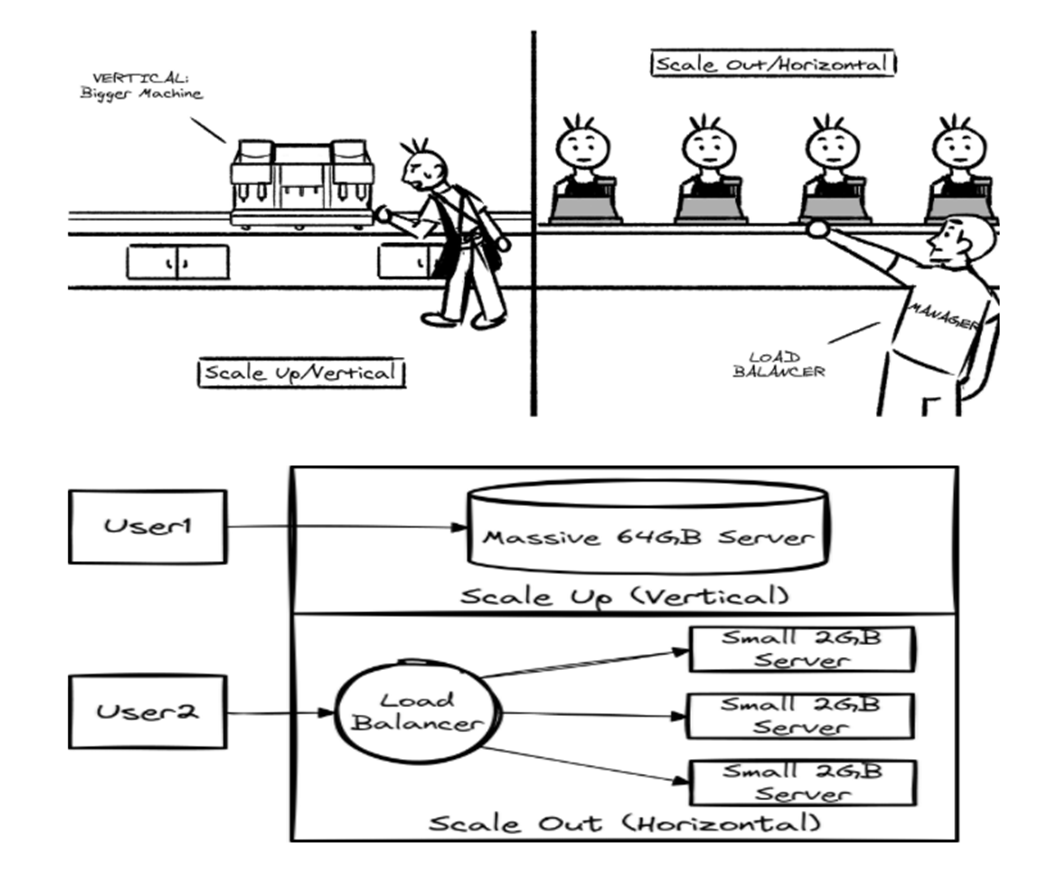
Compare a more powerful single worker with multiple identical workers. section 10.5.1
Good enough for now
An internal CSV export generated directly in a web request is quick to build, but it can time out for users with vast amounts of data. Accepting that limit may be reasonable for an immediate need; security, reliability, and data integrity may still be non-negotiable. section 2.5.1
Scale is a business decision, not a contest to build the biggest system. Describe the expected workload, the consequences of falling short, and the cost of extra capacity. An internal tool for 500 employees may not need infrastructure built for a viral traffic spike. section 10.5.1 section 2.5.1