Slope measures how a line changes vertically as it moves horizontally: rise divided by run. Geometrically, it is the incline or decline of a line segment. section 5.1.1
For a function, an interval gives an average slope. Shrinking that interval toward a point turns the secant-line measure into the slope of the tangent line, which is the derivative at that point. section 5.1.1
Use slope to:
- Measure whether a graph rises or falls and how sharply. section 5.1.1
- Match tangent directions where polynomial pieces meet, producing a smooth transition. section 7.1.1
- Turn a required tangent direction into a linear equation for polynomial coefficients. section 7.1.1
Constraining a polynomial tangent
For a quadratic P(x) = a₂x² + a₁x + a₀, the derivative is P′(x) = 2a₂x + a₁. Requiring slope 3 at x = 3 produces 6a₂ + a₁ = 3. Combining this equation with point constraints helps determine a polynomial with the desired tangent behavior. section 7.1.1
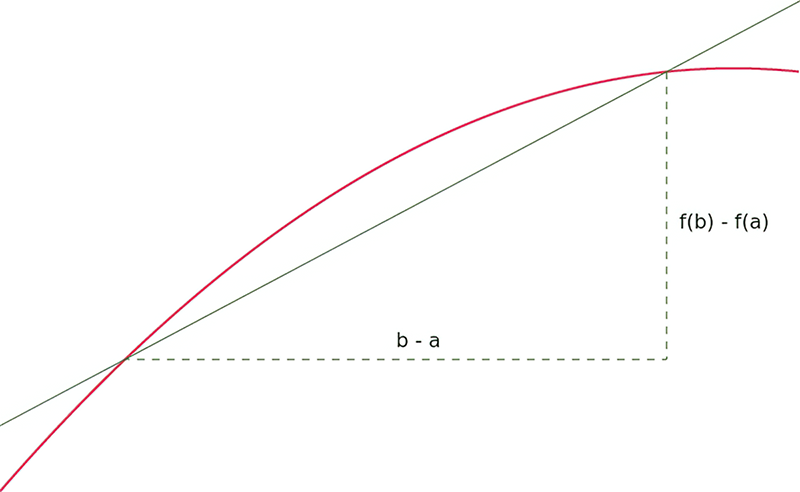
Visualizes average function change as the incline of a right-triangle hypotenuse. section 5.1.1
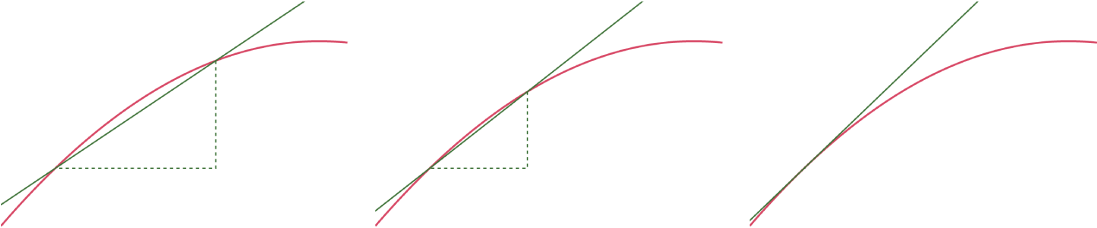
Shows how shrinking an interval makes a secant line approach the tangent line. section 5.1.1




