A statistical sample is a subset of observations used to learn about a larger population. Because the whole population is often inaccessible, statistics treats available data as a partial view and uses it to infer population attributes. A useful habit is to ask: what larger group, process, or set of possible events does this data stand for? section 2.4 section 2.6
A strong sample is representative: it reflects the population well enough that conclusions from the sample are useful for the population. Ideally, selection is random and unbiased, giving every population member an equal chance to be chosen. Random selection is not automatically easy, so the way data was gathered deserves scrutiny. section 2.6 section 2.21
Six sleep trackers, 64 residents
Suppose a dormitory has 64 residents, but only six smartwatches are available. Randomly selecting six residents produces a sample of size n = 6 from a population of size N = 64. If their mean sleep is 5.2 hours, that average is a hypothesis about all residents—not proof. Weekends, final exams, and a small sample may fail to capture usual variation. section 2.6
Figure 2.1 Randomly selecting six people in a dormitory to participate in a sleep study
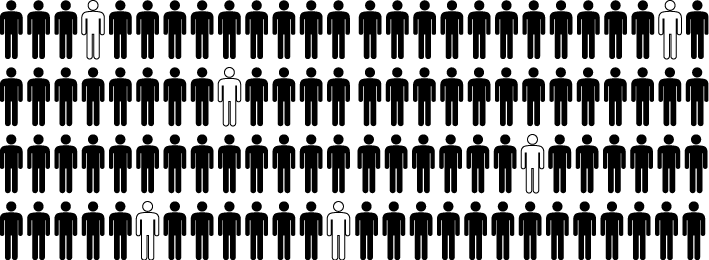
Use the selection diagram to distinguish the full dormitory population from the six people chosen for measurement. section 2.6
A population need not be a fixed, countable group. Road data from an entire self-driving taxi fleet can still be a sample of all possible road events. Likewise, historical airport on-time results can represent only one set of weather, schedules, and congestion conditions. This matters especially when using past data to predict an uncertain future. section 2.6
Treat sampling as a practical check on any data claim:
- Name the population the data is meant to represent. section 2.4
- Ask whether selection could exclude groups or introduce measurement bias. section 1.1 section 2.6
- Consider whether the sample is large and varied enough for the conclusion. section 2.6
- Interpret results as uncertain evidence rather than automatic truth. section 1.0 section 1.8






