liveBook · Manning

Database table

As explained in Amazon Web Services in Action, Third Edition: An in-depth guide to AWS

A database table is a relational data structure consisting of rows and columns that stores records of a defined schema.

A DynamoDB table is a named collection of items. Each item contains attributes, but items in the same table do not need to share the same attributes. section 12.2

Every table requires a primary-key schema:

  • A primary key uses one or two attributes to uniquely identify an item. A single-attribute key is the partition key. section 12.2.1
  • For a to-do application, a `todo-user` table can use `uid` as its partition key. Table creation also specifies attribute definitions and provisioned throughput. section 12.2.1

To-do application

Separate tables store users and tasks; items in those tables represent individual users and tasks. section 12.1
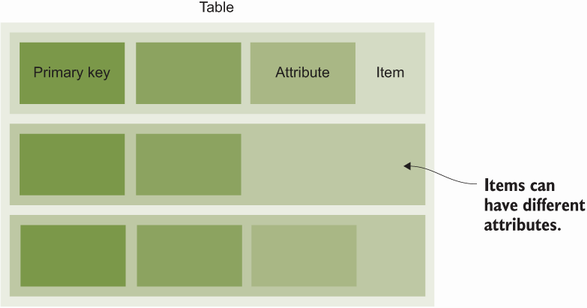
Figure 12.3 DynamoDB tables store items consisting of attributes identified by a primary key.

View the diagram connecting tables, items, attributes, and primary keys. section 12.2

How Amazon Web Services in Action, Third Edition: An in-depth guide to AWS covers it

How deep it goes
Defines items, attributes, flexible schemas, and primary keys, then demonstrates table creation with a partition key.
Examples
Uses separate user and task tables in a terminal to-do application, with `todo-user` keyed by `uid`.
What you can do after
Configure a DynamoDB table with a name, primary-key schema, and provisioned-throughput settings using the AWS CLI.
How it connects
Connects DynamoDB tables to items, attributes, primary keys, partition keys, and AWS CLI table creation.

Also explained in

Compare how 12 books explain database table →

Related concepts

This explainer was generated by Manning's knowledge graph from the text of Amazon Web Services in Action, Third Edition: An in-depth guide to AWS. The section links point to the parts of the book it draws on.










