An array organizes values into a regular structure. A matrix is a rectangular array arranged in rows and columns, giving algorithms a numeric form on which mathematical and statistical calculations can operate. section 7.7 section 1.2.2
Arrays connect raw data to machine learning representations. Image pixels can be stored as matrix values, while text words can be encoded as binary vectors. One-hot encoding illustrates the idea, but large vocabularies create sparse, high-dimensional matrices that are expensive to process. section 7.7 section 1.2.2
Encoding words as vectors
For “It is raining heavily,” lowercase the words, sort them as heavily, is, it, raining, and assign positions 0 through 3. The word “it” becomes [0, 0, 1, 0], while “heavily” becomes [1, 0, 0, 0]. section 7.7
Figure 1.4 An example of how unstructured data can be represented as a matrix to analyze. The matrix on the right is only an illustration and not the actual numbers.
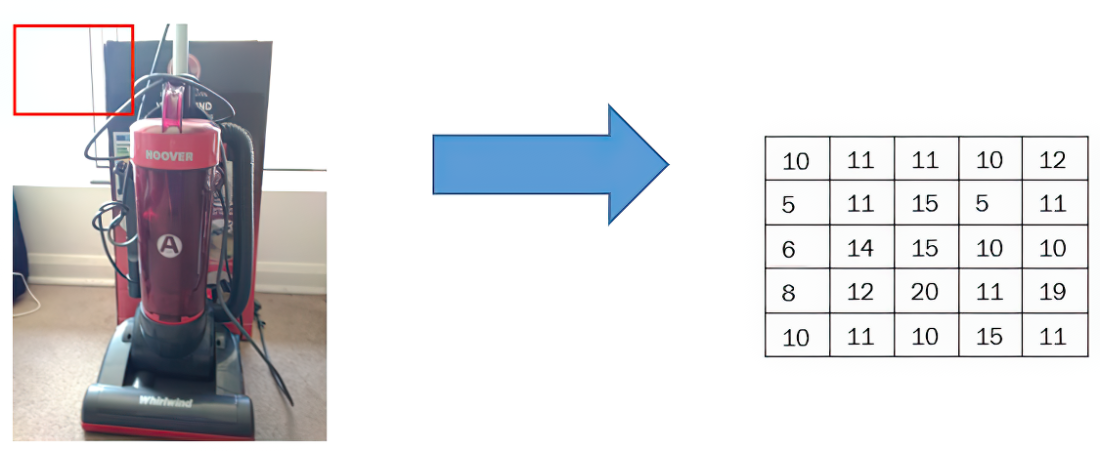
Use the illustration to connect an image region with its matrix representation. section 1.2.2







































