Text summarization condenses retrieved information into a shorter representation that preserves its most relevant factual content. In a knowledge-graph question-answering pipeline, it converts query results into an accessible textual overview alongside graph visualization. section 14.8
A reliable graph-result summarization pipeline:
- Capture the user question and the Cypher query used to answer it. section 14.8
- Provide the returned records and any currently selected nodes, including labels and properties. section 14.8
- Highlight important findings that may be buried in node properties or broader result context. section 14.8
- Present the summary with the graph so users can review a concise overview before exploring detailed relationships. section 14.8
Investigating a crime node
A generated summary identifies a crime as criminal trespass and extracts vehicle details from its narrative, including a black vehicle and a partial plate beginning with “EB.” section 15.3.1
Figure 14.12 Output generation pipeline, highlighting the system’s final stages of data presentation and analysis. Processed query results are transformed into visual presentations and analytical summaries, demonstrating the dual-output approach of visualization and summarization of query results.
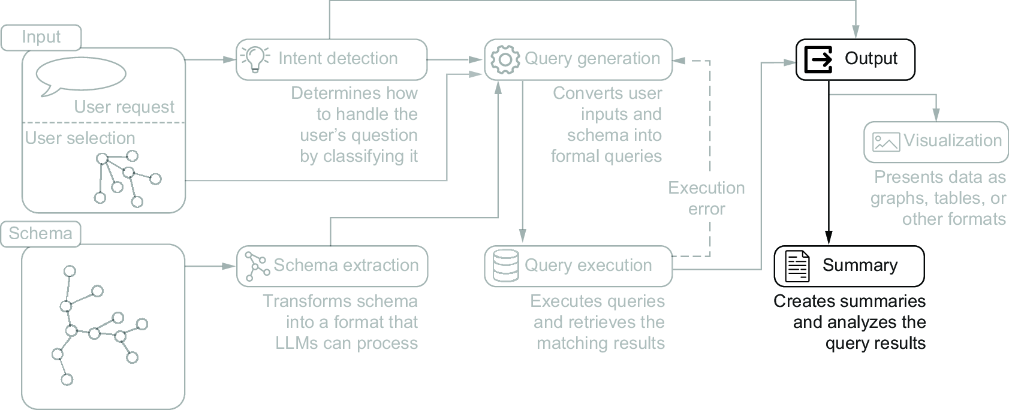
Use the pipeline figure to compare the two final outputs: visual presentations of processed query results and analytical summaries. section 14.8











