liveBook · Manning

Time series

As explained in ScyllaDB in Action

Time-series data is data associated with specific points or intervals in time, often subject to time-based expiration.

Time-series data is associated with specific points in time and is often deleted after a defined period. In ScyllaDB, this lifecycle makes time-windowed compaction a natural fit. section 8.4.1

Time-series data influences compaction choices:

  • Use TimeWindowCompactionStrategy (TWCS) when data is time-based or has a stable time to live. section 8.4.1
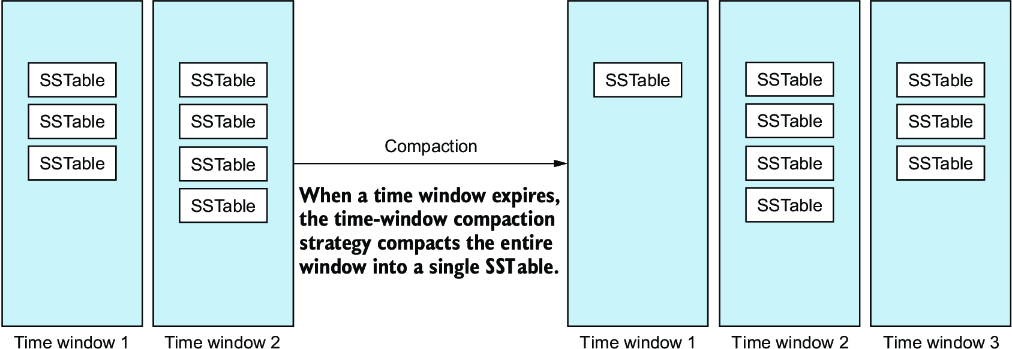
  • TWCS sorts data into time windows, applies size-tiered compaction within each window, and compacts completed windows into separate SSTables. section 8.4.1
  • Set the compaction strategy as a table property or change it with ALTER TABLE. section 8.4.1
Figure 8.18 TWCS is only used with time series data, dividing the data into windows and compacting it together when the window expires.
figure

The figure shows how TWCS divides time-series data into windows and compacts each window when it expires. section 8.4.1


How ScyllaDB in Action covers it

How deep it goes
Explains time association, expiration, time windows, and table configuration, without detailing broader time-series modeling.
Examples
Uses expiring data windows and TWCS compaction diagrams as concrete illustrations.
What it assumes
Assumes familiarity with tables and compaction while defining time association and expiration directly.
What you can do after
Operate ScyllaDB tables by selecting TWCS and configuring compaction through table properties or ALTER TABLE.
How it connects
Connects time-series data with time-to-live, compaction strategies, SSTables, and table configuration.

Also explained in

Compare how 9 books explain time series →

Related concepts

This explainer was generated by Manning's knowledge graph from the text of ScyllaDB in Action. The section links point to the parts of the book it draws on.






