A transformer is a deep neural-network architecture used to represent meaning in context. In search, its encoder can turn queries and documents into dense numerical vectors called embeddings. Comparing those vectors makes it possible to retrieve related content even when the words differ. section 13.3.1 section 13.4
The meaning of a word depends on its surroundings. A transformer uses attention to interpret each token in relation to other tokens in the input and relationships learned during training. It can encode that contextual meaning as vectors; a decoder can turn vector representations back into text. Search need not use both parts: an encoder alone can supply embeddings for retrieval. section 2.5.2 section 13.3.1
Context changes the query
“What is the difference between a capital and capitol?” calls for a different interpretation of capital than “What is the difference between a capital and lowercase word?” A context-sensitive model can distinguish the questions rather than treating capital as a fixed synonym or meaning. section 1.3.4 section 2.5.2
A transformer-based autocomplete or semantic-search pipeline can follow these steps:
- Pass corpus text through a transformer encoder and index the resulting embeddings. section 13.4
- Encode an incoming query with the transformer, then retrieve the k-nearest indexed vectors using a similarity measure. section 13.4
- Use the retrieved content to recommend related autocomplete terms or rank matching documents. section 13.4
Figure 13.5 A conceptual architecture for end-to-end search using Transformer-encoded vectors
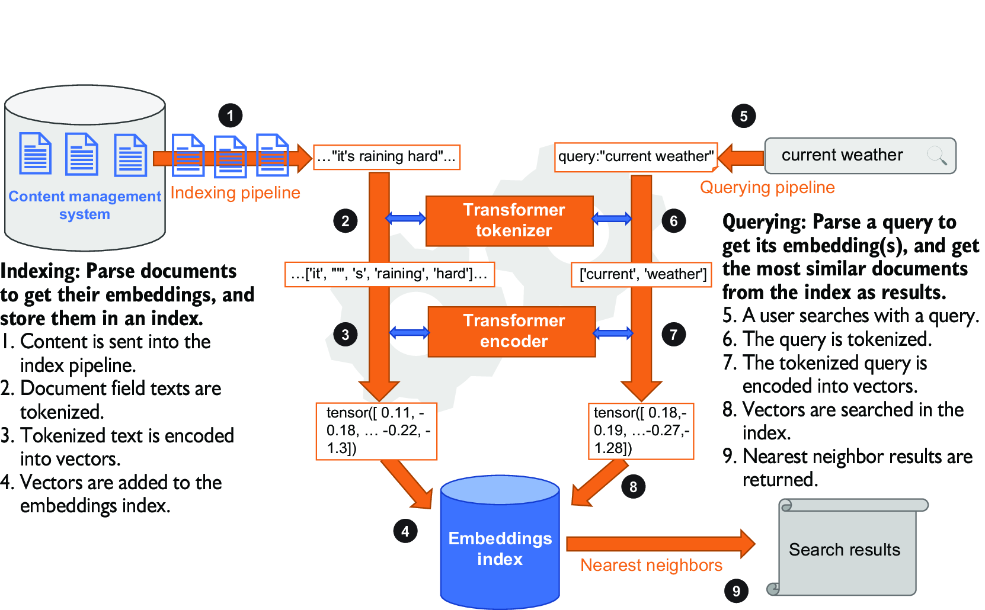
The end-to-end architecture diagram connects the content source, transformer-generated vectors, nearest-neighbor index, and query-time search. section 13.4
Training a transformer from scratch demands substantial computing power, time, and potentially large amounts of GPU memory. Pretrained models offer a practical starting point. Contextual embeddings also do not replace every search signal: when a query remains unclear, keyword search and domain understanding can provide useful fallbacks. section 13.3.2 section 2.5.2



























