A Transformer processes sequence elements with self-attention, examining relationships across an entire sequence in parallel. This architecture underpins large language models used for chatbots, translation, content generation, and coding tools. section 1.4
A Transformer turns a prompt into a representation through a few practical stages:
- Converts words into numerical identifiers that the model can process. section 1.4
- Tracks word positions so that sequence order contributes to meaning. section 1.4
- Uses self-attention to compare each word with the others and emphasize relevant relationships. section 1.4
- Processes the sequence in parallel across multiple layers, improving training efficiency and supporting very large models. section 1.4
Tracking relationships in a sentence
For “Jane helps Joe,” the Transformer represents the words, records that Jane comes first and Joe comes last, and evaluates how the words relate. The same relationship-focused processing helps interpret sentences such as “The dog chased the cat.” section 1.4
Figure 1.2 A transformer takes a sentence and analyzes word positions and relationships to try and extract meaning from the text it sees.
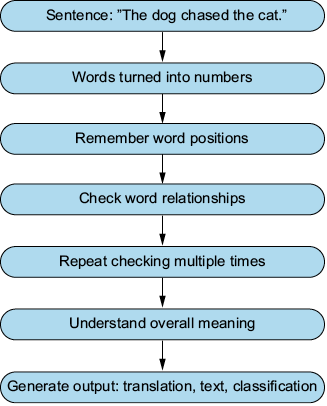
Use the figure to trace how word positions and relationships contribute to extracting meaning from a sentence. section 1.4



























