Underfitting occurs when a model is too simple to learn relevant patterns, producing high bias and high training error. In solubility prediction, insufficient model complexity can prevent an SVR estimator from capturing nonlinear relationships. section 4.4.3
Diagnose and address underfitting by comparing model complexity and error:
- Increase complexity when appropriate, such as raising PolynomialFeatures degree beyond 2. section 4.4.3
- Use validation curves to compare training and test performance across L2 regularization, polynomial degree, or epsilon-tube width. section 4.4.3
- Choose an intermediate complexity range rather than the simplest or most complex setting. section 4.4.3
Figure 4.21 How different errors (train, validation, generalization) and bias and variance change as a function of the number of data points (left, learning curve) or the model complexity (right, validation curve).
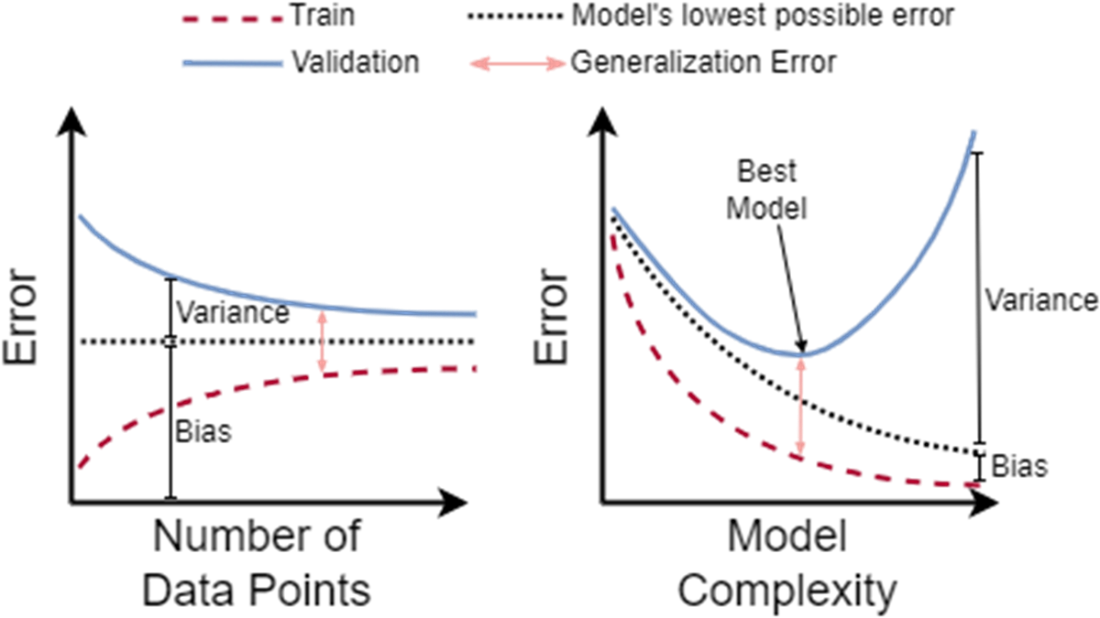
Compare how training, validation, and generalization errors change with model complexity, alongside bias and variance. section 4.4.3








