liveBook · Manning

Uri

As explained in Acing the CCNA Exam: Volume 2 Advanced Networking and Security

A Uniform Resource Locator is a standardized string that identifies a resource and specifies how to access it.

A Uniform Resource Locator (URL) identifies a resource and specifies how to access it. It is a type of URI, unlike a URN, which identifies a resource without giving its location or access method. section 3.1.1

A typical URL contains these elements:

  • Scheme: specifies the protocol used to access the resource, such as HTTPS. section 3.1.1
  • Authority: identifies the server, commonly through a domain name such as www.google.com. section 3.1.1
  • Path: identifies the specific resource on that server, such as /maps. section 3.1.1

Example URL

In https://www.google.com/maps, HTTPS tells the browser how to connect, www.google.com identifies the server, and /maps identifies the requested resource. DNS translates the domain name into an IP address before the computer sends packets. section 3.1.1 section 3.3

Figure 3.1 Elements of a URL. The scheme identifies the protocol, and the authority identifies the server’s name; they are separated by “://”. The path identifies the resource on the server.
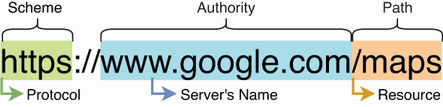
Use the URL-elements figure to inspect how the scheme, authority, separator, and path form a complete address. section 3.1.1


How Acing the CCNA Exam: Volume 2 Advanced Networking and Security covers it

How deep it goes
Breaks URLs into scheme, authority, and path, then stops short of detailed URL syntax beyond these common elements.
Examples
Uses https://www.google.com/maps to illustrate scheme, authority, path, and DNS resolution.
What it assumes
Teaches URI, URN, URL, and URL components directly while assuming basic familiarity with browsers and network access.
What you can do after
Evaluate URL components and understand how a browser uses DNS to locate the named server.
How it connects
Connects URI, URN, DNS, domain name, IP address, HTTPS, and web browsers.

Also explained in

Compare how 9 books explain uri →

Related concepts

This explainer was generated by Manning's knowledge graph from the text of Acing the CCNA Exam: Volume 2 Advanced Networking and Security. The section links point to the parts of the book it draws on.






