A variational autoencoder (VAE) generates new data points that resemble its input data while allowing variation. For images, that can mean creating faces or designs similar to those it has learned, rather than exact copies. VAEs can also support anomaly detection and recommendation systems. section 4.1
A VAE has two neural networks. An encoder maps an image to a lower-dimensional latent space that captures essential features. Instead of choosing only one latent point, it represents a distribution described by a mean and variance. A decoder samples from that distribution and reconstructs an image. Different samples allow different, related outputs. section 4.1.1
Figure 4.4 Variational autoencoder architecture
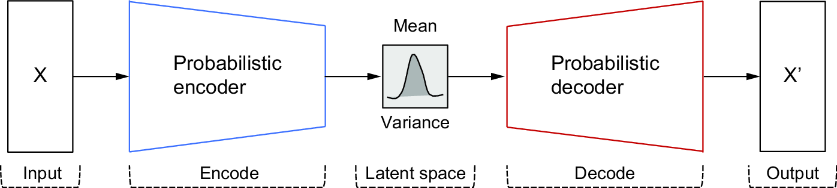
Follow the input through the encoder, latent representation, and decoder to see where sampling enters the generation process. section 4.1.1
Useful image tasks include:
- Generating images that share features with training images, such as faces, fashion designs, or art. section 4.1.1
- Reconstructing missing or corrupted image regions, including in medical images or old photographs. section 4.1.1
- Transferring stylistic elements between images or manipulating image features. section 4.1.1
Choose the architecture to fit the task. VAEs are suited to producing varied data similar to the original, including relatively simple images; GANs target greater realism in complex, diverse images, while diffusion models target high-quality modeling of complex data when generation speed is less important. A VAE can also be a component within a diffusion system. For deployed image generation, consider image quality, speed, computing resources, training data, and questions of ownership and authenticity. section 4.1 section 4.1.4












