liveBook · Manning

Voxel

As explained in Robotics for Programmers

A voxel is a discrete volume element, typically cubical, used to represent occupancy in a three-dimensional grid.

A voxel is a small, usually cubic volume in a 3D grid. A volumetric model represents a shape by recording which voxels it occupies, much like pixels represent a 2D image. section 6.1.5

Voxel representations make complex shapes explicit as occupied volumes, but introduce practical trade-offs:

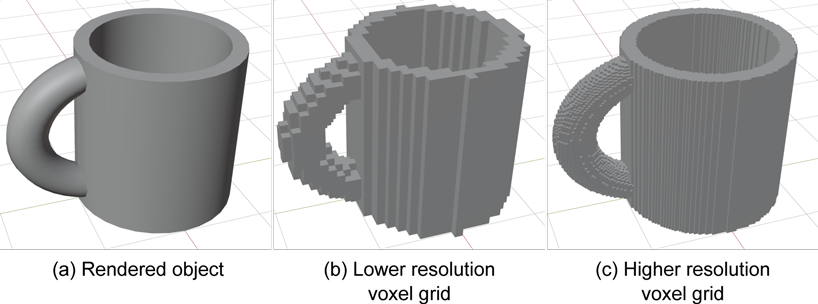
  • Grid resolution controls geometric detail: finer voxels capture more detail but require many more volume elements. section 6.1.5
  • Unlike boundary representations, voxels do not primarily describe connected faces, edges, and vertices; they discretize space into occupied cells. section 6.1.5
  • Adaptive subdivisions such as octrees can represent volumes more efficiently than a uniformly fine grid. section 6.1.5
Figure 6.15 Volumetric models use a grid of voxels (3D pixels) to discretize 3D space and represent complex shapes; the resolution determines the level of geometric detail.
CH06 Fxx bihlmaier voxels

Use the figure to visualize voxels as 3D pixels whose grid resolution determines the level of geometric detail. section 6.1.5

How Robotics for Programmers covers it

How deep it goes
Defines voxel grids and explains resolution costs, then stops short of implementation details or volumetric algorithms.
Examples
Illustrates voxelized shapes through a figure showing a 3D grid whose resolution controls geometric detail.
What it assumes
Assumes familiarity with three-dimensional space and pixel-based grids, while introducing their volumetric counterpart.
What you can do after
Evaluate voxel grids as a shape representation while recognizing their resolution and storage-efficiency trade-offs.
How it connects
Connects voxels with pixels, volumetric models, octrees, boundary representations, meshes, and point clouds.

Also explained in

Compare how 3 books explain voxel →

Related concepts

This explainer was generated by Manning's knowledge graph from the text of Robotics for Programmers. The section links point to the parts of the book it draws on.
