Sensor noise is variation in a measurement around the real value an ideal sensor would report. A temperature sensor alternating between 23 °C and 24 °C can be noisy even when the actual temperature is 23.42 °C. All real sensors are imperfect, so acceptable noise depends on the application and its accuracy, size, and cost tradeoffs. section 1.2.2
Distinguish ordinary noise from more serious measurement problems:
- Noise usually keeps measurements distributed around the real value; for many sensors, a normal distribution models this bell-shaped variation, with large outliers rare. section 1.2.2
- An incorrect measurement may be far from the real value or unrelated to it, even while the sensor is functioning; strong magnetic fields can disrupt some joint position sensors. section 1.2.2
- Simulation commonly provides ideal sensor data without noise, drift, or errors; richer sensor models can add these effects to expose real-world constraints. section 5.1
From virtual sensor to robot estimate
A simulated rotary position sensor can read a virtual joint’s ground-truth position directly, producing ideal data. Adding noise and drift makes the sensor data less ideal, while RViz can display the robot’s incomplete estimated state from virtual camera observations rather than the simulator’s complete ground truth. section 5.1
Figure 5.1 A robotics simulator replaces the real world with a virtual environment by providing virtual sensor data to the virtual robot, receiving virtual actuator commands from the robot software, and computing the time evolution of the virtual world according to a physics engine.
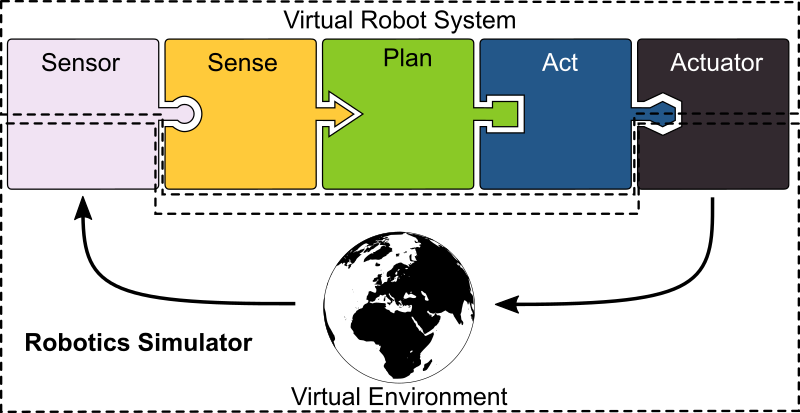
Use the simulator model to see how virtual sensor data flows from a virtual environment into robot software, alongside actuator commands and simulated world evolution. section 5.1















