Bias is systematic distortion in an estimated effect. In causal analysis, it can arise when treatment assignment differs systematically because of factors also associated with the outcome. section 5.2.1
Choosing a medical treatment
Suppose physicians compare surgery with no surgery using observational data. Age, sex, hospital, radiological findings, and prior illnesses may influence both treatment choice and outcome, making the estimated treatment effect biased. Identifying and adjusting for such confounders can improve the estimate of the average treatment effect. section 5.2.1
Bias can also appear when a time-related event changes the relationship between an outcome and its controls. Predictions of the counterfactual outcome may then reflect those changes rather than the event alone. section 11.3.3
Figure 5.7 Main diagram for this section. C denotes a vector of confounders, T stands for treatment, and O stands for outcome.
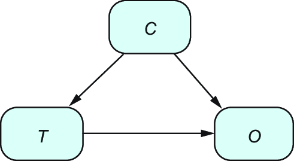
A causal diagram links confounders, treatment, and outcome, making the possible route to biased estimates visible. section 5.2.1



























