In a neural network, the intercept is the learnable bias term: an additive parameter that shifts a unit’s pre-activation independently of its weighted inputs. It is analogous to the constant c in y = mx + c, while weights play the role of slopes. section 8.2.2
Use the intercept to understand how a perceptron and a trained network make predictions:
- A perceptron combines input values with weights and a bias before applying its activation function. section 8.2.2
- Weights and biases are trained parameters; learning searches for values that improve prediction accuracy across network layers. section 8.3
- During feed-forward propagation, hidden layers process data using activation functions, weights, and bias terms before producing a prediction. section 8.3.2
Face identification
A face-recognition network learns weights and bias values from labeled face images. During feed-forward propagation, those parameters help transform image attributes into a probability that the face belongs to a particular person. section 8.2.1 section 8.3.2
Figure 8.3 A neuron gets the inputs, processes them using mathematical functions, and then generates the output.
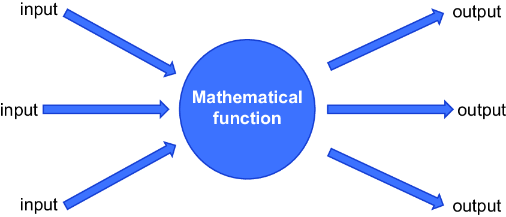
A neuron diagram helps connect the intercept to the flow from inputs through mathematical processing to an output. section 8.2.2






